
Ten years ago, if you wanted to buy something, you probably drove somewhere. Now most people just pull out their phone. That one shift is basically why an online store stopped being optional for businesses — it’s become the main way a lot of customers expect to reach you in the first place.
Here’s what nobody tells you before you try building one though: putting a few product photos on a website is the easy 20%. The other 80% is what actually decides whether someone buys — navigation that doesn’t confuse people, a checkout that doesn’t die at the last step, payments that go through, stock numbers that are actually correct. Most DIY attempts fall apart somewhere in that 80%.
That’s really where Technoholic comes in. We build stores that are secure, fast, and built around how your business actually runs — not a template we’re reusing for the fifteenth time. We look at what you sell, who buys it, how your process works today, and where you want to be a couple years out, and we build toward that.
Starting from scratch, moving an offline business online, fixing a store that isn’t converting, or building a full multi-seller marketplace — we’ve done all of it, start to finish: planning, design, build, integrations, testing, launch, and the maintenance after.
Strip away the jargon and it’s really just this — building the place where people browse, buy, and check on their orders, and giving you a back-end to run all of it without losing your mind.
For customers, that’s usually the catalog, search, filters, category and product pages, cart, wishlist, checkout, payment, accounts, and order tracking.
For you, it’s managing products and stock, processing orders, handling customers, running discount codes, setting shipping rules, tracking payments, pulling reports, and editing site content without calling a developer every single time. How much of this you actually need depends entirely on what you’re selling and how.
A store that’s built properly doesn’t just sit there. It’s open at 2am when someone’s scrolling in bed. It works whether they’re on a laptop or a five-year-old phone. It doesn’t need a person standing behind a counter for a sale to happen.
Done well, this lets you sell past your local area, take payments without friction, keep stock organized without a messy spreadsheet, automate the repetitive order stuff, and actually understand your customers instead of guessing at what they want.
I’ll be honest though — a good website by itself won’t save a bad product or a nonexistent marketing plan. What we build is the foundation. Everything else still has to hold up its end.
We work with startups just getting going, small businesses stepping online for the first time, and bigger brands that have outgrown whatever they started with.
Custom e-commerce websites. Not every business fits an off-the-shelf platform, and honestly, trying to force it usually shows. When your checkout logic or pricing structure is a bit unusual, custom development gives us the room to build around that instead of around some template’s limitations.
WordPress & WooCommerce. Flexible, well-supported, and a good middle ground for businesses that want real control without starting completely from zero. We set up products, variations, categories, gateways, shipping, coupons, order flow — then customize further with plugins or custom code wherever the defaults fall short.
Shopify. If you’d rather have a more hosted, structured setup with less to manage technically, Shopify’s a solid pick. We do the store setup, theme work, product and collection config, navigation, payments, app integrations, and general tuning.
Fully custom platforms. Some businesses genuinely need something no existing platform handles well — unusual pricing logic, multiple vendors, deep enterprise integrations. Here we build from the ground up, architected to hold up as you scale, not just handle what you need today.
B2C stores. The standard direct-to-consumer setup. Product discovery, reviews, wishlist, cart, checkout, tracking — all built to make buying as painless as possible.
B2B platforms. Selling to other businesses is a different game — negotiated pricing, bulk orders, minimum quantities, quote requests, multiple logins per account, invoicing. B2B varies wildly by industry, so this gets built around your actual sales process, not a generic assumption of what B2B “should” look like.
Multi-vendor marketplaces. Letting several sellers operate on one platform needs more architecture than a single-store build — vendor sign-up, seller dashboards, commission splits, payouts, admin oversight across everyone involved. We plan for that complexity from day one instead of bolting it on later.
Design. Good UI isn’t about chasing trends — it’s about someone finding what they want without frustration. Homepage, listings, product pages, cart, checkout, all of it needs to just make sense.
Product catalog. A huge catalog with no real structure is just noise. Categories, attributes, variations, specs — organized so shoppers can find things fast and your team can manage it without a headache.
Search & filters. If someone can’t find a product in a few seconds, they leave. We build filtering by keyword, price, brand, size, color, rating — whatever actually matters for what you sell.
Cart & checkout. Honestly, this is where most sales quietly get lost. A cart that’s upfront about pricing and shipping, and a checkout that doesn’t spring surprise fees on someone right before they pay — that alone moves the needle on completed orders more than people expect.
Payments. Cards, net banking, wallets, UPI, whatever your market actually uses — plus proper handling for refunds and transaction logs.
Shipping & delivery. Rate calculation, delivery zones, tracking, and hooking into whatever courier partners you already use.
Inventory. Nobody wants to sell something that’s actually not there. Stock tracking, low-stock alerts, and — if you sell across multiple channels — syncing so the numbers stay right everywhere, not just on the website.
Order management. One place to see status, payments, shipping, and history for every order, from placed to delivered (or refunded).
Customer accounts. Saved addresses, order history, wishlists — the small stuff that turns a one-time buyer into someone who comes back.
A website almost never runs alone. We also cover:
Got a store already but it’s underperforming — dated design, confusing navigation, people abandoning at checkout? We also do redesigns and migrations. Redesign work is based on what’s actually broken, using real customer behavior, not just a fresh coat of paint. Migration covers moving products, customers, order history, and SEO value from one platform to another without losing data or tanking your search rankings on the way.
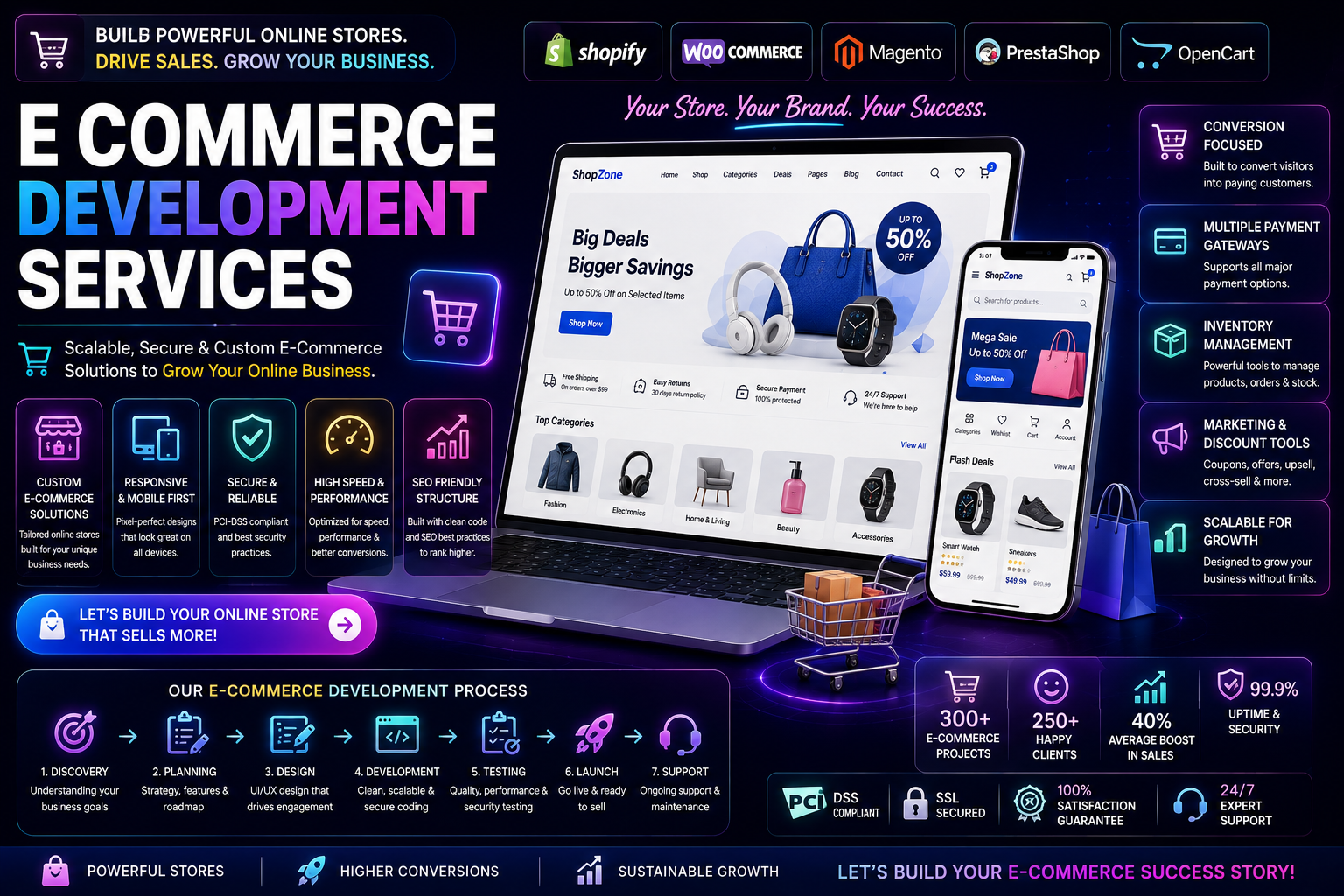
First, we understand the business — products, audience, sales process, payments, shipping, and what you’re trying to get out of this. Then we figure out the right platform, whether that’s WooCommerce, Shopify, or something fully custom. From there it’s planning the actual buying journey, designing around your brand rather than a stock look, and building out the catalog, cart, checkout, and accounts.
Once that’s built, we integrate whatever you need — payments, shipping, CRM, ERP, analytics — and test everything properly: functionality, responsiveness, payments, security, performance. Then we launch. And honestly, launch day is the start, not the finish — we keep optimizing after, and stick around for updates, fixes, and improvements as the business changes.
Fashion, electronics, beauty, furniture, grocery, healthcare products, education, sports gear, food, B2B products, retail, manufacturing, professional services, digital products. The build changes with the industry, but the core approach — build around what your business actually does — stays the same every time.
Big catalogs get messy fast. Product variations multiply quicker than you’d expect. Payment integrations don’t always cooperate. Shipping math changes by region. Keeping inventory synced across channels is genuinely hard, not just annoying. None of this is unusual — it’s just what real e-commerce projects run into, which is exactly why planning and testing before launch matters as much as it does.
We’re not trying to squeeze your business into whatever template we already have sitting around. We build based on what you’re actually doing — custom development, WooCommerce, Shopify, B2B, marketplace, or something that doesn’t fit neatly into any of those. Catalog and inventory work, payment and shipping integration, CRM/ERP connections, SEO structure, performance tuning, migrations, ongoing support — it’s all part of the same job to us.
A store that sells around the clock. A customer base bigger than your physical location could ever reach on its own. Digital payments that just work. Less manual grunt work on products and orders. Customer data you can actually use instead of guessing. And infrastructure that scales with you rather than needing a rebuild every time you grow a bit.
To be fair, the site is one piece of a bigger picture — product, pricing, and marketing still matter a lot. But a well-built store is what actually lets SEO, ads, email, and social marketing convert, instead of sending traffic to a page that leaks it right back out.
Building a real e-commerce platform takes more than uploading a few product photos. It needs decent UX, secure payments, real order management, working inventory, mobile responsiveness, fast load times, and someone who’s still around after launch to keep it running properly.
That’s the work Technoholic does — custom stores, WooCommerce, Shopify, B2B, B2C, marketplaces, payments, shipping, inventory, integrations, SEO, migrations, and support that doesn’t disappear after the invoice.
Whether you’re launching your first store, moving an existing business online, building a B2B ordering system, or setting up a full marketplace — let’s talk about what that actually looks like for you.