
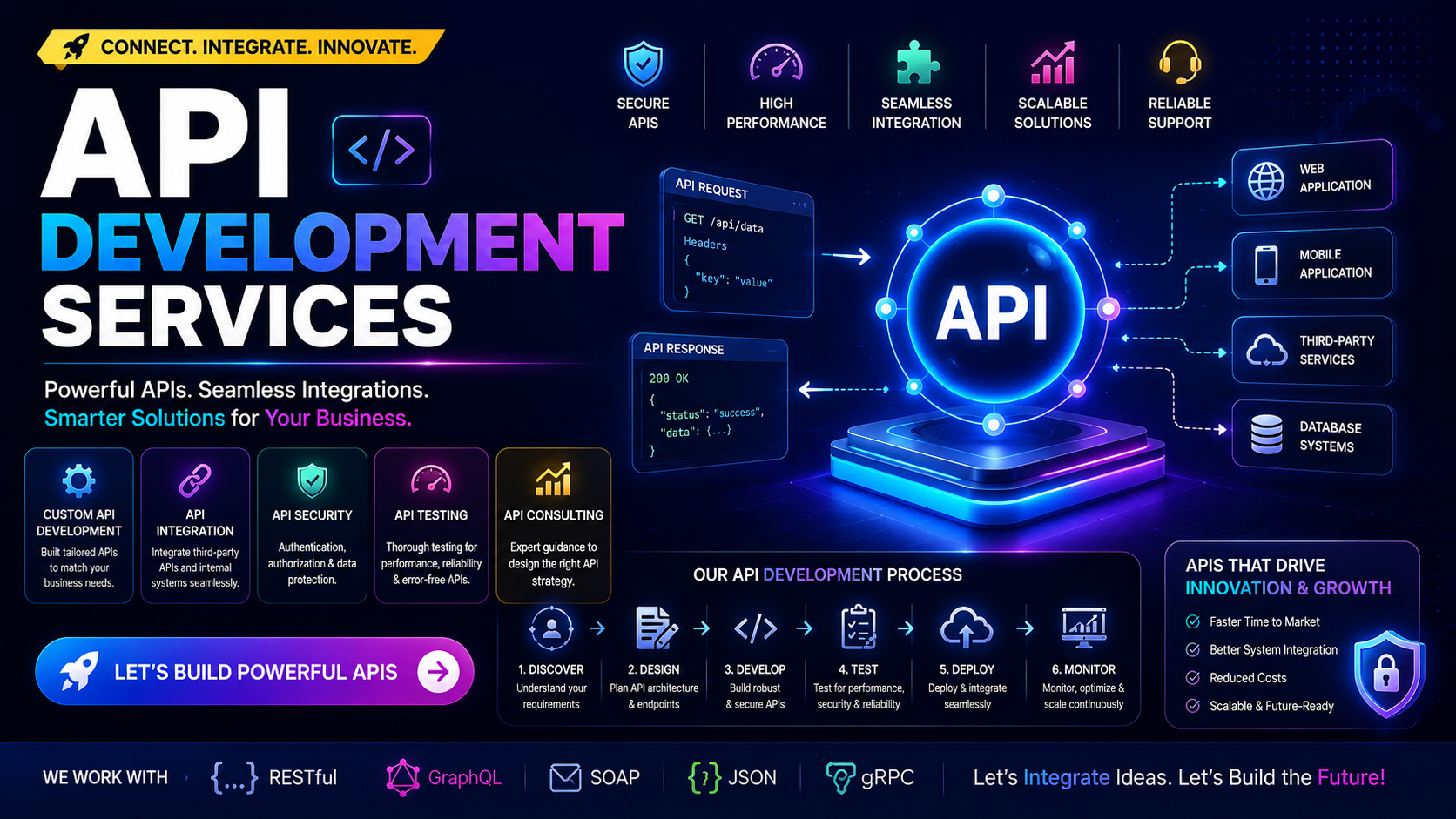
TCI Tech’s API Development Services help connect modern, complex systems.Software modules need to connect to do their jobs—web/mobile apps, CRMs, ERPs, payment processors, business tools, databases, and third-party apps.Technoholic’s API Development Services help businesses build secure, high-performance, and scalable APIs.Technoholic builds structured, scalable, and secure APIs for custom software, mobile apps, SaaS apps, web apps, enterprise systems, and third-party integrations.
API development is the design, building, testing, deployment, and maintenance of systems that provide pathways for software systems to communicate.
Well-designed APIs provide methods for requesting and exchanging data. APIs can connect internal and external systems, mobile and partner applications, and systems with publicly available integrations.
API development includes:
The business needs, security needs, and the architecture and tech are based on the expected data and traffic, the application needs, and the needs of the business.
More and more businesses are utilizing many different digital systems for diverse aspects of their operations. In the absence of proper integration, employees have to input the same data in multiple systems, which results in increased work and increased potential for errors. APIs are designed to enable the connection of disparate systems and facilitate the structured movement of data across the systems. API development empowers businesses to:
A well thought out API is a critical component of a business’s digital framework.
Technoholic offers a comprehensive suite of services for API development that range from the technical to the business side and cover the entire API development life cycle. We have the capability to develop APIs that support new systems and extend/upgrade existing systems.
Business applications have unique requirements and as such, generic integrations may not be wholly sufficient to meet the needs of the business. Technoholic recognizes the need for custom APIs in order to enable businesses to support special application functions and workflows.
The components of a Custom API development may include:
Custom APIs offer the flexibility to accommodate the unique functional requirements of different web and mobile applications, enterprise applications, and SaaS applications.
REST APIs are a common architectural pattern for web and mobile applications and the backend systems they communicate with. They rely on the standard HTTP methods to manipulate resources.
The most common methods include:
Developing REST APIs will provide a flexible and structured way for applications to communicate with backend services.
REST APIs can be developed in Technoholic with necessary resources, authentication, validation, error handling, and documentation based on the needs of the project.
Rather than developing a new system to meet every business functional requirement, most businesses will rely on the integration of multiple software systems. For applications to be able to communicate with and utilize the services of other software systems, they must have the APIs to support this.
Some of the available API integrations include:
The nature and quality of an integration is largely dependent on the API documentation, the authentication methods that the API supports, the provided endpoints, the data the API accepts and returns, and any constraints that may be in place.
A lot of businesses prefer to use external systems for specialized services. Rather than developing every feature, a business can integrate a service with its API.
Examples include:
Third-party integrations help businesses customize their applications by utilizing established external services, while also minimizing development time.
There is a growing demand for payment processing across different industries, including e-commerce, mobile applications, subscription-based services, and other online businesses.
Payment APIs help applications interact with payment systems for:
Integrating a payment API requires addressing security and authentication, along with handling errors and status for transactions.
Customer Relationship Management systems store, and helps manage customers and leads. APIs can bridge websites, applications, forms, marketing platforms, and various other systems with a CRM.
Integrating with a CRM API can enable:
For instance, using an API, a contact form on a website can send data to a CRM and eliminate the need for manual data entry.
Enterprise Resource Planning systems usually cover multiple business functions, including sales, purchasing, accounting, operations, and inventory. APIs help connect ERP systems with other business applications.
Integrating with an ERP API can enable:
Integrating ERP systems with mobile applications, websites, or other platforms enables businesses to operate in a more interconnected manner.
Backend APIs are usually how mobile applications upload and download data. In this case, mobile applications serve as the front end, and the APIs serve as the back end.
Mobile APIs can be developed to manage:
APIs can be developed to supply mobile applications with needed content and services while keeping the backend separate from the front end.
To support modern flexibly designed applications, Web APIs are used for back end and front end communications.
Web APIs can be developed to manage:
APIs can support a more modular and flexible web application design.
To support client configurable services and modular applications, many SaaS Platforms utilize APIs.
SaaS Platforms can utilize APIs for:
To support client configurable services, many SaaS Platforms utilize APIs designed around modular services, authentication, and changeable system design.
APIs are used to support many services, and security becomes a large concern, when APIs provide access to data and services.
To support security, APIs implement user authentication and service authorization.
Depending on the nature of the project, API security may involve:
API security architecture is dependent on the nature of the application, users, data, integrations and the security requirements.
During development, the security of APIs should be a priority. APIs can gain backdoor access to the application’s backend via the front end.
Security of APIs involves:
Security should be prioritized during the architecture and development of APIs as opposed to adding security after the completion of the APIs.
Documentation for APIs is critical when the API is implemented by external development teams or by multiple development teams within the organization.
The documentation should cover:
Well-documented APIs minimize the time taken to integrate them and reduce the complexity of API maintenance.
API testing is the process of validating the functional and non-functional aspects of an API including the security and performance of the API prior to exposing the API for public or widespread use.
The tests may cover:
The complexity and importance of an API will dictate the tests that should be performed.
The performance of an API can impact the responsiveness of a website or mobile application.
Optimization of performance may include the following:
The aim is to provide acceptable response times whilst still ensuring accuracy, security, and reliability.
As applications grow, the number of requests made to an API may grow exponentially. APIs must therefore, be built to accommodate growth.
API architecture can be built to accommodate:
The aim of scalable architecture can be driven by the needs of the service and its clients.
As applications grow, the need for changes in an API may increase. Changes in an API may include the addition of new features and functions, and changes to the the way in which existing features and functions operate.
API versioning is the control mechanism that is used to provide the changes, and will minimize the breaking changes that new features may cause to the existing applications.
To grow an API, while versioning will control the changes, the integration of older functions will be maintained to provide a controlled path to the changes.
The versioning of an API should be planned according to the the expected life of the API.
The deployment of an API is not the end of the development of an API. Changes in business requirements and in the external services that a business relies on may prompt the need to change an API, along with an increase in the need to meet changing security standards.
The maintenance of an API will include:
An API that is maintained will provide a guarantee that the applications that are connected to the API will continue to function.
APIs may be functionally independent of other APIs. Complex applications may be designed with a microservices architecture.
APIs let these services work together.
Microservices based API architecture supports:
Not all applications need microservices. Choose this type of architecture if the project is complex, has many requirements, and has a long vision.
APIs can help, for example, automate the transfer of data between systems, which can eliminate the need to perform data transfers manually.
One example of an API workflow is an online form submission which can be configured to result in:
Other examples of API workflow automation include:
The API automation eliminates the need to perform data transfers manually and improves the workflow between the systems.
Technoholic has a clearly articulated process that helps us develop API services that meet the technical and business demands of the projects we undertake.
We gather and analyze information including the intended application, business needs, users, data, desired integrations, workflows, and the expected functionality of the API.
Prior to development, we plan the structure of the API, its endpoints, data models, methods of authentication, how the API will integrate and be scaled.
We determine the resources of the API, methods of requests, structures of responses and errors, and other related technical requirements.
In accordance with the approved architecture the API and the required back end functionality is developed.
We connect the API to a database to enable it to manage application data, and provide the required services to create and/or update data.
Appropriate measures for authentication, authorization, validation, and security are applied according to the needs of the project.
The API is checked for various requirements including functionality, how data is handled, error conditions, authentication, and applicable integrations.
For API endpoints and integration approaches, documentation is created to assist developers in using and understanding the offered endpoints.
As per the project’s infrastructure, the API is deployed to the required server or cloud environment.
The API, after deployment, can be maintained and monitored to improve performance, resolve issues, and implement security updates, as well as fulfill new requirements in the future.
Connected digital systems are essential for most modern businesses and rely on integrated systems. Because of this, API development can be concentrated on any industry.
Technoholic can develop or integrate APIs for:
Requirements for specific industries may be accommodated with a flexible design of both API integration and architecture.
With poor design, API development can lead to integration issues, security problems, and performance concerns.
Common problems include:
Professional API development focuses on these issues during the design and construction of the API.
APIs are the connective tissue for so many digital solutions and services. Technoholic knows this well. Our practices for API Development Services are built with this understanding in mind, emphasizing:
API Development Services provided by Technoholic include:
A professionally developed API can provide a strong technical foundation for connected applications and business systems.
Key benefits include:
The actual benefits depend on the application architecture, API design, integration requirements, and implementation.
APIs can drive digital transformation by bridging the gaps between once isolated systems. Instead of having to live with silos, businesses can create integrated ecosystems that allow multiple digital services and solutions to share and exchange data.
A business may link its
systems using Application Programmable Interfaces to offer a connected and automated business workflow.
with the aid of their API Development Services, businesses can connect numerous services and systems via the programmable interfaces that APIs provide. APIs can connect mobile apps, websites, customer relationship management systems, enterprise resource planning systems, payment systems, software as a service and e-commerce applications, and enterprise applications.
API development is not simply creating the endpoints. It requires the developer to address system design, data design, access control, security, testing, documentation, and performance of the APIs as well as scalability and the support of the APIs after deployment.
Our clients can expect the fullest range of API Development Services, tailored to the specific needs of the client, on each project. Based on the APIs we provide, businesses can create cohesive and connected systems.
Technoholic supports the full lifecycle of planning, developing, integrating, testing, and providing the necessary support of APIs to fulfill the client’s long-term business and technical requirements, whether the client is connecting systems or creating an automated workflow through the design of a scalable SaaS product.