
Imagine walking into a store where the lights flicker, the shelves are disorganized, the staff ignores you, and checkout takes forever. You would leave immediately. Now imagine the same experience happening to someone who visits your website. The result is the same – they close the tab and they do not come back.
In today’s market, your website is your storefront, your salesperson, your customer support desk, and your brand ambassador, all working together, 24/7, in every time zone on the planet. A poorly built website does not just look bad (although it does). It costs you customers, credibility, and business.
At Technoholic, we have helped hundreds of businesses build their digital presence with custom website builds tailored to their needs. We have worked across industries and have seen website builds that fail and those that work.
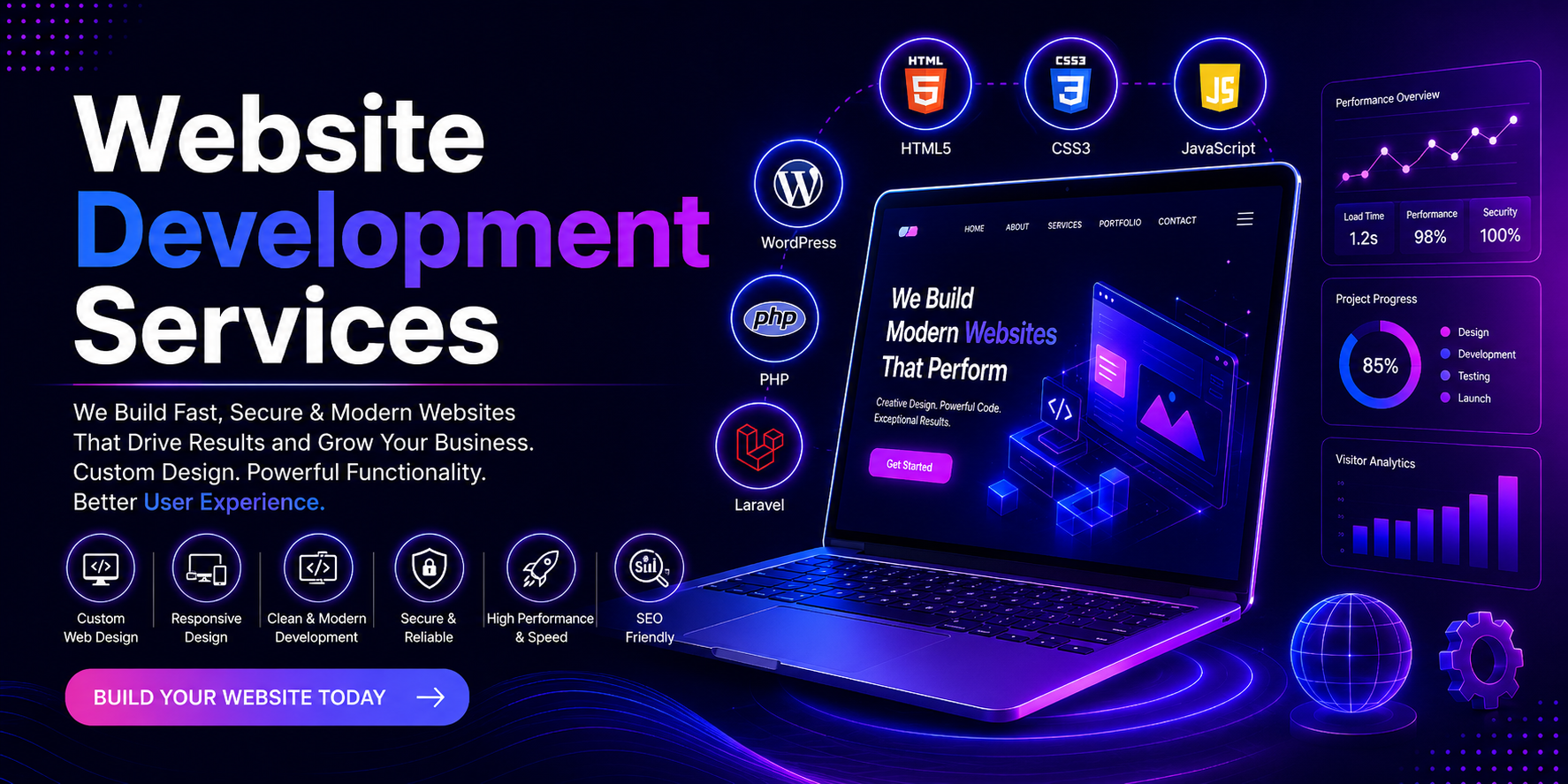
This guide will provide you with everything you will need to know when considering professional web development services; from different types of websites, technologies used, the web development process, costs, and how to best choose a web development partner.
As used here, website development comprises the build and maintenance of both websites and web applications. Because of the close association of website development and web design, many people confuse the two.
Web design focuses on the user experience and the appeal of the site, incorporating elements such as visual design and user interface (UI) elements.
As for website development, this focuses on the implementation of the design. This includes both the functional and technical aspects of the website. Some examples of this would include implementing the website’s back-end designs and data structures, optimization of servers and security, and the implementation of website functionalities.
Website development merges and connects both web design and development. Technoholic specializes in delivering these services. An attractive and appealing design devoid of functionality and technical robustness is useless, and the reverse is just as true. The goal and Technoholic’s focus is bridging this gap.
The purpose of different websites varies. Knowing the purpose of your website is absolutely essential before you start the development process.
Static websites contain a fixed, prebuilt design, and each page is built to provide the same information to each of its visitors. Static websites are fast, secure, and cost effective, making them appropriate for small business websites, portfolios, landing pages, event listings, and other one page websites.
Best for: Small business websites, landing pages, event pages.
Technologies: HTML5, CSS3, JavaScript, Static site generators like Hugo and Jekyll.
Dynamic websites generate content in real time. This means that the content displayed to users is constantly changing. For example, certain content may change based on the time of day or may be customized based on the user’s history and preferences.
Examples: News sites, booking sites, educational sites, membership sites
Technologies: Python (with Django or Flask), PHP, MySQL, PostgreSQL
Nowadays, to build an online store requires much more than just displaying your wares; it involves building a complete back end to handle payment transactions, inventory management, order fulfillment, and shipping. On top of these frameworks, it’s necessary to optimize your site to handle a large number of concurrent users.
At Technoholic, we have a great deal of experience with e-commerce development. We understand that time and lost sales opportunities occur with every second of additional load time and broken steps in the checkout process.
Bests for: Retail, Subscription Services, D2C brands, Multi-vendor marketplaces
Technologies: Shopify, WooCommerce, Magento, Custom
Content Management Systems (CMS) allow non-technical users to manage, publish and update site content without coding. CMS based sites also allow users to add and manage site media, blog posts, and page content. This is the most popular approach to site development for business use cases that require regularly published content.
Bests for: Agencies, Corporate websites, Media sites, Blogs
Technologies: WordPress, Joomla, Drupal, WebFlow, Sanity
Web Applications are software applications that are built and deployed on the web. Web Application examples include Project Management Tools, Custom Web based CRM Systems, Booking Platforms, and SaaS dashboards. Web based application development is very complex and requires a large amount of architecture and API integration to support user authentication and data manipulation.
Bests for: Enterprise Applications, Healthcare portals, Finance applications, SaaS
Technologies: Vue, React, Angular, Node APIs
Progressive Web Apps (PWAs) combine the elements that make websites and mobile applications great. PWAs load in a user’s browser like a website. Yet, like mobile apps, they can be installed on a device, function offline, emit push notifications, and perform at app-like speeds, without the need for a download from the Apple or Google app stores.
According to Technoholic, businesses with mobile app requirements should look into PWAs as they are a less expensive option than developing native applications for iOS and Android.
Best for: Mass media, retail, and service industries.
Technologies: JavaScript web application, Service Workers, Web Application Manifests.
Developing a professional website is more involved than writing some code. There is an overall process of which best practices are implemented to build a website that minimizes the risks involved in the development and maximizes quality. Here’s how Technoholic approaches website development.
Before codes are even written, we like to learn about the client’s business. This involves:
This phase produces the main project document called the Project Brief, which is the primary project artifact and forms the basis for all the decisions taken henceforth in the project.
This stage of the development process focuses on building the structural framework of the website and the manner in which information will be organized and how navigation will be done. In this stage, page structure and content hierarchy are represented through low-fidelity visual designs (wireframes).
The Design Team uses the approved wireframes as a basis to create high fidelity mockups that incorporate your brand identity. This means designing for your brand with typography, color selection, and visual hierarchy, as well as designing for mobile, tablet, and desktop by creating flexible layouts and designing for interactivity. It also means designing for accessibility by compliancing with the WCAG standards.
Each of our designs goes through thorough testing to guarantee the design will be easy to navigate and understand by the end user.
The Front End Development process is taking the design and bringing it to life by using code. This is what the user interacts and engages with.
The Front End Team is responsible for:
The Back End development process is the foundation of the website that is not visible to the user. This stage consists of:
Disregarding proper back end development also leads to slow loading websites, poor security, and an inability to support growth. We design back ends that grow with your business.
Before going live, all Technoholics sites go through many phases of testing.
Testing includes functionality checking, load performance, security, cross-device, and SEO audits to name a few.
Site testing includes functional testing to make sure every element, feature, and form on the site performs as expect, and every link is operational.
We perform load performance testing against the Core Web Vitals standards set by Google.
We perform security testing to validate the integrity and security of the site by scanning for web vulnerabilities and conducting SSL tests and validation.
We perform cross-device testing for every operating system (iOS, Android, Windows, macOS) to ensure that the site renders without errors.
An SEO audit checks for the meta tags, validates the sitemap, verifies and corrects the site’s robots.txt, and confirms the markup and SEO page speed.
We perform accessibility testing for compliance screening, so sites are compatible with screen readers and controlled with only a keyboard.
Launch is only the first step in getting a site to perform for your business. Technoholic manages the entire process for deploying your site, configuring your hosting, and setting up your domain name and CDN with analytics configured.
We provide:
As per today’s standards, if your site does not contain these features, your site is outdated.
The majority of the world’s Internet traffic is generated on mobile devices (over 60%). Any site that does not perform optimally on mobile devices stands to lose the majority of its potential traffic.
According to Google’s site speed research, 53% of users leave sites that take more than 3 seconds to fully load. Our sites load in under 2 seconds.
SSL Certificate (HTTPS): Data security comes first. When it comes to your website and your visitors, SSL certificates protect their data. Google ranks non-HTTPS sites lower.
SEO-Ready Architecture: In order to maintain your front-end architecture for SEO, you need to have optimized heading structures and fast loading sites with clean URLs and schema markup.
Clear Calls to Action (CTAs): Having a goal in mind is important for each of the pages on your site. Depending on your site’s needs, they can lead to a quote, demo, or purchasing page.
Live Chat or Chatbot Integration: Chat solutions help reduce visitor drop-off and help move potential new customers to buying customers. Technoholic offers integrations for popular chat solutions like Tidio and Intercom, as well as custom chatbot solutions.
Analytics Integration: Additionally, solutions like Google Analytics 4, Microsoft Clarity, and Hotjar should be installed and configured to begin capturing user behavior data, even before your site is fully operational.
ADA/WCAG Accessibility Compliance: Building sites with these accessibility standards is not only the right thing to do, it is required in a lot of markets.
Websites of all kinds require development and come with a cost. The development price is affected by the size, complexity, and the team building it. The range below is what you should expect.
Complexity Level of Website Developed | Estimated Cost Range |
Basic Static Website (5–10 pages) | $500 – $2,500 |
CMS Website (WordPress/Webflow) | $2,000 – $8,000 |
E-Commerce Website | $5,000 – $25,000 |
Custom Web Application | $15,000 – $100,000 |
Enterprise-Level Website Build | $50,000 – $500,000 |
More web development projects means lower per-project costs to Technoholic, allowing for more transparent and Value-Based pricing. Every project begins with a detailed scope and fixed-cost agreement.
You can find plenty of website development solo practitioners, agencies, and offshore development shops, all competing for your business, claiming to build you a world-class website for less. What you should delve into:
At Technoholic, we marry strategic and technical precision with client-centric communication into a powerful combination. We do not only develop websites; we build partnerships.
Every website Technoholic built is delivered with three unbreakable commitments:
Your audience develops an opinion of your business in under 0.05 seconds, and you really can’t afford to be average. A website that is built professionally is not a cost, it is one of the highest return on investments a business can make.
Whether you want to build a website for your new business, redesign your old one, or run your website that is now popular beyond your expectation, Technoholic has the necessary team and process to give you an edge that will perform with great results.
The internet is not waiting for you, and your business shouldn’t have to either.