Skip to content
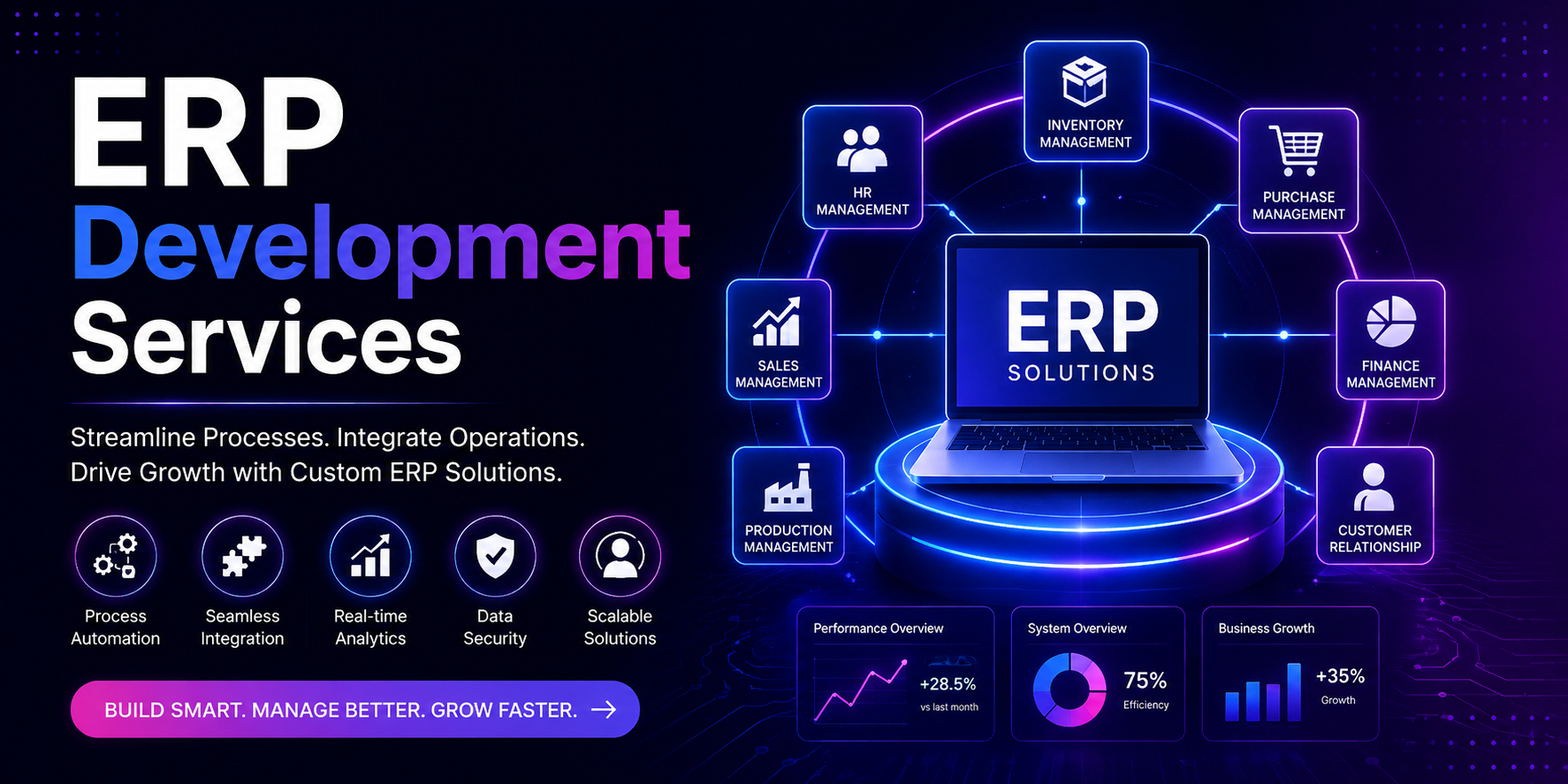
ERP Development Services integrate the various aspects of your business to provide comprehensive performance data, reducing the challenge of duplicate and/or disparate data entry and providing performance data in a single, consolidated format. Technoholic ERP Development Services build the solutions our clients need to manage their organizations’ day-to-day operations, to improve data visibility and automate business practices and processes.
What is ERP Development?
From finance to sales, HR to procurement, a company’s operations span a variety of different departments. Robust business solutions often require multiple disparate systems to manage the different functions. An ERP Development solution integrates all processes to provide a business with the comprehensive, real-time performance data it needs in a single, consolidated platform.
An optimized ERP solution can be built around the size and operational complexity of a business and its industry. This makes ERP development particularly useful for systems that address complex workflows and functions, or that address gaps in desired business functionality.
Key elements of most ERP systems include the management of:
- Financing and accounting
- Sales management and Customer relationship management
- Management of employees
- Inventory and warehouse management
- Management of sourcing and buying
- Project and task management
- Reporting and analytics of businesses
What is an ERP System?
An ERP system is a way to link different sections of the business through a central database and a shared software. When data is entered or updated in one area of the system, users in the relevant departments who are authorized, can access the updated data.
For instance, when a sales order is created, the inventory department can see the stock data that is needed, the finance department can take care of the billing data, and higher management can see the transaction through the operational reports or business dashboards. Connected workflows help eliminate redundant data entry.
The standard workflow of an ERP solution is typically:
- Capturing data from multiple business functions
- Data retention in an integrated database
- Automation of routine operational workflows
- Integration of relevant workflows in different business functions
- Reporting and dashboard presentation to management
- Setting access limits based on user roles
What Are the Building Blocks of ERP?
A basic ERP solution is a mix of modules designed to support different facets of business. A custom ERP development approach allows companies to select, modify, or build modules based on existing business needs.
Finance & Accounting
The finance and accounting module handle a business’s financial records, reporting, payments, expenses, invoicing and more. It benefits both finance teams and management in that it streamlines the tracking of financial records of the business.
- Invoicing and Billing
- Track Incomes and Expenses
- Manage Accounts Payable and Receivable
- Payment Management
- Financial Reporting
- Tax Records
Human Resource Management
Tracking employee data becomes cumbersome as an organization grows. A HR module integrated with ERP provides a central space for employee data and processing typical HR tasks.
TheseTasks could include
- Editor Em data
- Attendance and Leave
- HR Processes Related to Payroll
- Recruitment
- Employee Documentation
- Performance Details
Inventory & Warehouse Management
Being able to manage your inventory is especially important for businesses that sell products or run an operation that incorporates manufacturing, distribution, or multiple warehouses. ERP systems help in managing inventory and understanding the stock available, stock sold, and stock that needs to be sourced.
These Systems Typically Provide Functionality For
- Stock and Product Management
- Warehouse Management
- Monitoring Stock Movement
- Purchasing and Sales Inventory
- Low Stock Notifications
- Reporting on Inventory
Sales & CRM
When ERP integrates customer and sales data, businesses can manage the customer and sales process in one connected system. Sales teams can manage leads, follow-ups, sales quotes, orders, and customer data without the use of disconnected tools.
The module may include:
- Lead and customer management
- Sales pipeline tracking
- Quotations and sales orders
- Follow-up management
- Customer records
- Sales performance records
Procurement Management
Procurement management aids businesses in creating order visibility and visibility of suppliers and purchase needs. When connected with the inventory and finance functions, procurement provides a purchasing workflow with more structure.
It can include:
- Supplier management
- Purchase requests
- Purchase orders
- Vendor records
- Approval workflows
- Purchase tracking
Project Management
Project management can be integrated into an ERP system by businesses that manage multiple projects to help with the organization of tasks, teams, and the progress of multiple projects. This also can provide management with an overview of the activities and the projects.
Typical functions include:
- Project planning
- Task management
- Team assignment
- Resource allocation
- Tracking of project progress
- Budget allocation
Why ERP Development is Important for Organizations
Developing an ERP system has additional value for a business beyond the integration of functions. The main value of building an ERP system lies in the integration of business processes. Businesses will then have the ability to connect departments with each other and have pertinent information available at the management level without the hassle of integrating multiple systems.
A proper ERP system has the capability of helping a business achieve:
Better Operational Efficiency
An ERP system can automate routine tasks, free employees from the burden of repetitive work, and can make processes more effective. Employees spend less time transferring information and time on productive business activities.
Centralized Business Information
Instead of using many applications, spreadsheets, or documents, an ERP system brings data associated with the business into a central database. This makes the data easier to access and manage.
Improved Data Accuracy
Manual input of data repeatedly results in inaccurate data. A system that connects to the ERP workflow can help reduce the duplication of data entries.
Faster Decision-Making
Management can gain insights into running business data through the ERP system. The business operations data promptly available in organized format allows for faster, informed business decisions.
Better Coordination of Departments
A connected ERP system helps businesses integrate their workflow of multiple departments and functions. It brings together discrete processes and supports coordination.
Scalable Business Operations
Flexible ERP systems help address the changing operational needs as a business grows. Our ERP systems can be easily expanded with more users, workflows, modules, and system integrations when needed.
ERP Development Process
Unlike many competitors, we begin our ERP development process by learning about your business instead of starting to code. Every business has different workflows, users, approval processes, reporting needs, and pain points. These aspects must be addressed so your ERP system meets your business requirements.
Our process generally includes:
Requirement Analysis
We take the time to evaluate your business and the challenges you face so we can determine what your ERP system will need to do.
Planning & Architecture
The requirements help us plan the architecture of the system, the database, and the integrations. We also develop the modules and determine the workflow structure and scalability.
UI/UX Design
We design systems that help businesses run. We address each user group’s needs through the design of the ERP system’s dashboards and workflows.
4. Development
The approved system architecture and workflows are used to develop the required ERP modules and associated business functionality.
5. Testing
The system is tested across multiple modules and workflows in order to find functional issues, integration issues, usability issues, and other kinds of errors.
6. Deployment
When the ERP system completes its testing, it can be deployed to the required environment and made available to the user community.
7. Maintenance & Support
After deployment, maintenance on the ERP system is required to keep the system secure, stable, and updated in order to meet changing business needs.
Custom ERP Development vs Ready- Made ERP
Ready- made ERP software provides business functionality, but every business operates in its unique way. A business may have unique approval processes, reporting requirements, workflows, and industry specific operations that cannot be addressed by standard systems.
Custom ERP development provides the ability to design the system around those specific needs. A business can choose to include the modules required and have the flexibility to develop additional functionality when needed.
Custom ERP solutions provide the following:
- Business Workflows
- Customized dashboards
- Industry specific modules
- Customized reports
- Role-based access controls
- Third party integrations
- Scalable functionality
This approach is ideal for businesses that have specialized processes or that anticipate a need for changes in the future.
ERP Integration Services
Most businesses use more than one software application to run their operations. They may use a payment system, an e-commerce system, a CRM system, accounting software, communication systems, or other business applications.
Integrating an ERP system links multiple systems together to allow seamless data exchange. Based on specific business demands, Technoholic can build integrations for:
- Payment gateways
- CRM systems
- E-commerce tools
- Accounting software
- HR and Payroll systems
- Inventory management software
- Business APIs
- Communication tools
Integrations can streamline data flow and minimize the need for repetitive data inputs across systems.
Cloud-Based ERP Development
Cloud-based ERP offers authorized users the flexibility to access a company”s applications and data from anywhere with an internet connection. This can be useful for businesses that have employee work sites beyond the primary business location.
A cloud-based ERP can support:
- Remote business access
- Centralized information
- User management
- System flexibility
- Infrastructure scalability
- Easier system updates
- Multi-location operations
The appropriate cloud architecture depends on the organization’s security, scalability, integration, and operational needs.
Role-Based Access & ERP Security
ERP systems store sensitive business information that includes financial records, employee data, customer data, and operational information. Therefore, access control should be prioritized as an ERP development component.
Role-based access involves the able to customize the system permissions for users that define their view, edit, approval, or management rights.
As an Example, limitations can be applied to:
- Administrators
- Managers
- HR
- Finance
- Sales
- Inventory
This helps businesses manage their data and the system functionality with greater efficiency.
Industries That Can Benefit from ERP Development
ERP solutions are customizable across all industries. The specific modules and workflows are based on the focus and requirements for the business operation.
ERP development has many benefits for:
- Manufacturing businesses
- Retail businesses
- E-commerce businesses
- Healthcare businesses
- Educational institutions
- Logistics businesses
- Construction businesses
- Real Estate businesses
- Distribution businesses
- Professional Service businesses
- Hospitality businesses
- Small and Medium Enterprises
Some common challenges that occur while developing ERPs are:
- Multiple departments
- Workflows
- Users
- Data sources
- Poor requirement analysis
- Poor system architecture
- Understanding business workflows
- Data migration
- Integrations
- Designing engaging UX/UI
Addressing these challenges requires careful understanding of the business requirement and a proper development process.
At Technoholic, we provide ERP development services.
We build custom business-aligned ERP systems.
- Scalable architecture
- Simple UX
- API integrations
- Workflows
- Third party integrations
- Reporting and Dashboards
- Custom Modules
- Technical support
- Customization
We provide Maintainance and Technical support.
We don’t take a one size fits all approach!
Conclusion
Connectivity across some or all of the functions of finance, HR, sales, purchases, inventory, and customer management is a key benefit of enterprise resource planning (ERP) systems. These systems help organize and automate processes and reconnect companies that have outgrown a disconnected system. ERP systems enable business users to control, manage, and even analyze business processes by improving the flow of information and increasing the visibility of business activities.
No single feature of an ERP system is the most important. Iterative design, systematic access, reliable integrations, testing, and business-focused support are also important for building a system that businesses can rely on.
Regardless of whether your company is a growing enterprise looking to automate daily operations, or an established company requiring a customized enterprise platform, Technoholic provides solutions to create Enterprise Resource Planning systems based on your company’s business processes, operational needs, and future growth.