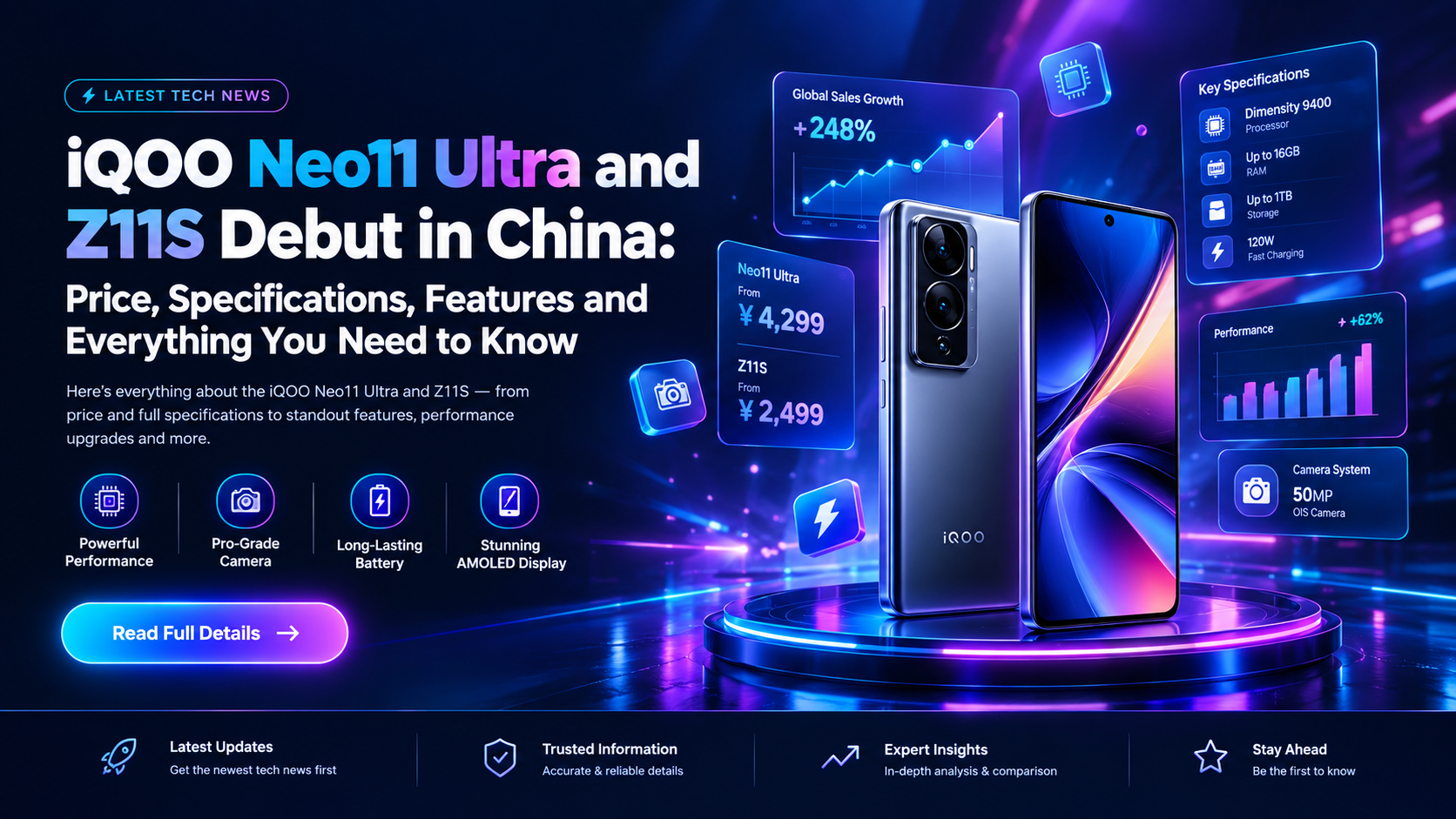
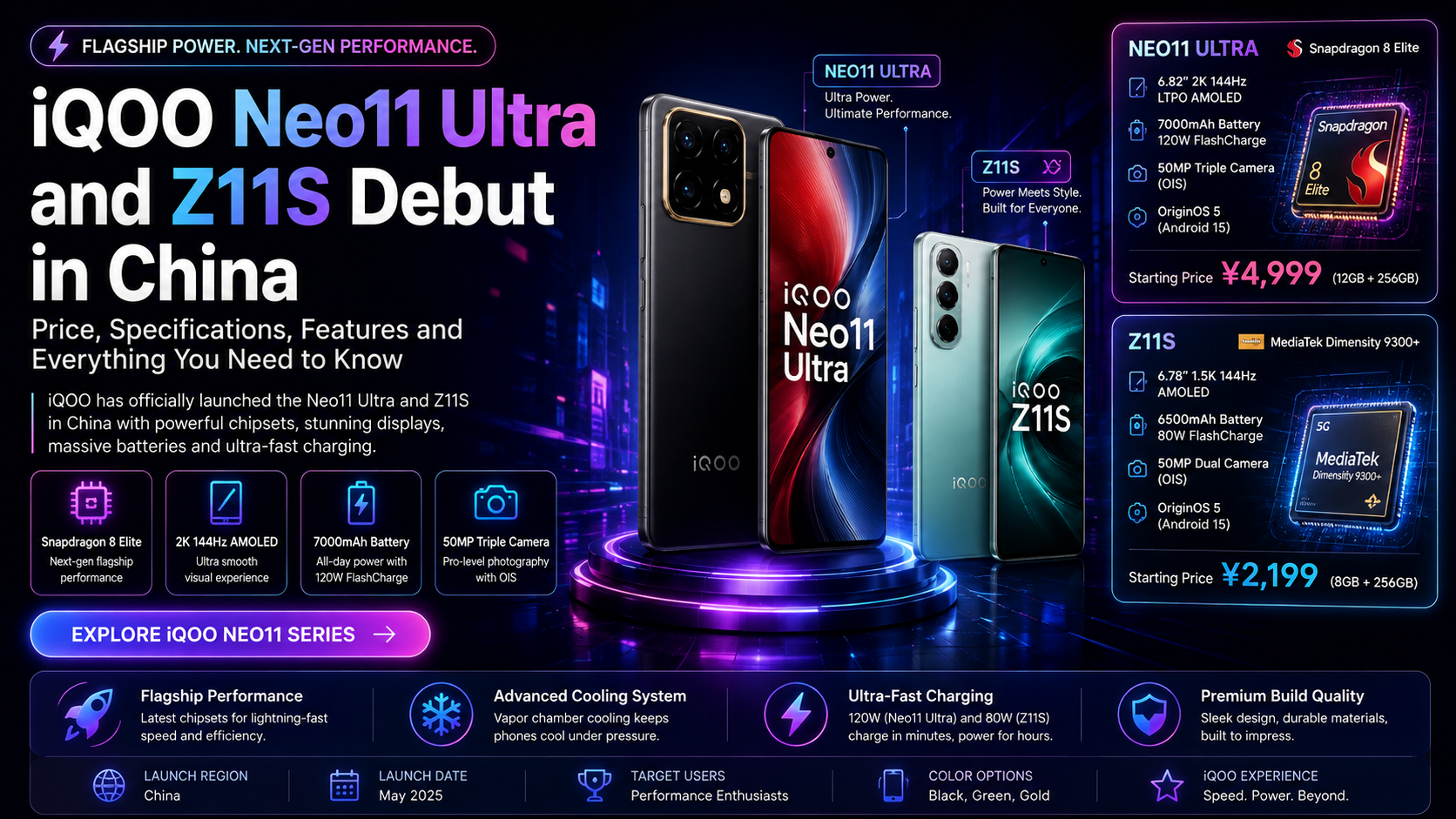
iQOO doesn’t really do quiet launches, and this week was no exception. The company has officially rolled out two new phones in China — the Neo11 Ultra and the Z11S — and between them, they cover pretty different corners of the market. One’s a performance-first gaming phone with a genuinely massive spec sheet. The other is a battery-first budget option that happens to pack in more mAh than any iQOO phone before it. Here’s everything worth knowing about both.
iQOO Neo11 Ultra: The Performance Pick
Let’s start with the flashier of the two. The Neo11 Ultra marks something of a naming shift for iQOO — previous high-end Neo phones used the “Pro” suffix, so calling this one “Ultra” signals the company wants it treated as a genuine flagship-tier device rather than just an upper-mid-range option.
At the heart of it sits MediaTek’s Dimensity 9500M, paired with iQOO’s own Q2 gaming chip. That combination is doing a lot of the heavy lifting here. According to leaker DigitalChatStation, the chipset is a deeply customized version of the standard Dimensity 9500, holding a 4.21GHz clock speed across all the large cores while swapping one GPU core for iQOO’s own MC11 unit. Whether that trade-off actually helps or hurts real-world performance is something we’ll only know once independent benchmarks start showing up, but iQOO is clearly betting on it.
Memory-wise, buyers get up to 16GB of LPDDR5X Ultra RAM running at 9,600Mbps, paired with UFS 4.1 storage topping out at 512GB. There’s also an 8K Ice Dome 3D VC liquid-cooling system on board, which iQOO claims lets the phone run open-world mobile games at ultra-high settings and a steady 60fps, even in a 26°C room. Big claim, and one that’ll need real-world testing to confirm, but the hardware behind it — an 8,000mm² vapor chamber — is at least a serious attempt at solving the heat problem that plagues most compact gaming phones.
The display is a 6.83-inch flat panel using Visionox F2 LTPS OLED material, running at 2K resolution (3200×1440) with a 144Hz refresh rate. Peak brightness is rated at up to 4,500 nits, and touch sampling can hit 4,000Hz in its most responsive mode — numbers that matter a lot less for everyday scrolling and a lot more for competitive mobile gaming, where every millisecond of input lag counts.
Battery life comes courtesy of a 9,100mAh silicon-carbon cell, which is enormous for a phone this size, especially one that still manages a relatively svelte 9.13mm profile. Charging tops out at 100W wired, and bypass charging support means you can game while plugged in without stressing the battery with a constant charge-discharge cycle. On the camera side, you’re looking at a 50MP Sony LYT700V primary sensor with OIS and an f/1.88 aperture, an 8MP ultrawide, and a 16MP selfie camera up front. Nothing groundbreaking there — this isn’t a camera-first phone — but it’s competent enough not to be a weak point.
Rounding things out: IP68 and IP69 ratings, a 3D ultrasonic in-display fingerprint scanner, dual stereo speakers, an X-axis linear motor, and OriginOS 6 running on top of Android 16. It comes in three colorways — Chengfeng White, Jiying Black, and Chiguang White — with the last one apparently featuring a 3D dynamic texture on the rear panel.
As for pricing, the Neo11 Ultra starts at CNY 3,399 (roughly $475) for the 12GB/256GB base model, climbing to CNY 3,799 for 16GB/256GB, CNY 3,999 for 12GB/512GB, and CNY 4,399 for the top 16GB/512GB configuration. It’s already up for sale through iQOO’s official Chinese store, with first-sale discounts sweetening the deal for early buyers.
iQOO Z11S: Battery Life Above Everything Else
If the Neo11 Ultra is about chasing performance, the Z11S is about chasing hours of screen-on time. This is iQOO’s first phone to break past the 10,000mAh mark, and that alone makes it worth a look if battery anxiety is your main phone-shopping concern.
Under the hood sits MediaTek’s Dimensity 7500, a solid mid-range chip rather than a flagship one, paired with LPDDR4X RAM (up to 12GB) and UFS 3.1 storage going as high as 512GB. It’s clearly not aiming to compete with the Neo11 Ultra on raw horsepower, and that’s fine — this phone is playing a different game entirely.
The display is a 6.83-inch AMOLED panel at 2,800×1,260 resolution, still hitting that same 144Hz refresh rate as its pricier sibling, with up to 2,000 nits of peak brightness. iQOO’s leaned hard into eye-comfort marketing here too, touting full-brightness DC-like dimming, 2,160Hz PWM dimming, and SGS certification for low blue light and reduced flicker — the kind of feature set aimed squarely at people who spend hours a day staring at their phone and want fewer complaints from their eyes by the end of it.
That headline 10,000mAh battery pairs with 44W wired charging, which is noticeably slower than the Neo11 Ultra’s 100W — a fairly reasonable trade-off given how much bigger the cell actually is. Camera-wise, it’s simpler too: a single 50MP main sensor around back with an f/1.8 aperture, and an 8MP selfie camera up front. No ultrawide here, so if you’re someone who actually uses that second lens regularly, it’s worth keeping in mind before buying.
The rest of the spec sheet mirrors its sibling more closely than you might expect at this price: IP68/IP69 protection, an optical in-display fingerprint scanner, an IR blaster, Wi-Fi 6, Bluetooth 5.4, NFC, dual-SIM 5G, and OriginOS 6 on Android 16. It’s available in three colors — variously listed as Floating Light Across Ten Thousand Miles, Snowy Isle White, and Ink Rock Black, which is a genuinely delightful naming choice even in translation.
Pricing starts at CNY 1,799 (around $267) for the base 8GB/128GB variant, rising through CNY 1,999, CNY 2,299, and topping out at CNY 2,699 for the 12GB/512GB configuration. Like the Neo11 Ultra, it’s already live for purchase through iQOO’s official online store in China.
How the Two Compare
Put side by side, the split in priorities is pretty clean. The Neo11 Ultra is chasing benchmark scores and sustained gaming performance, backed by a genuinely serious cooling setup and a higher-resolution display built for competitive use. The Z11S trades almost all of that for one thing: raw battery endurance, wrapped around a chip that’ll comfortably handle everyday tasks without needing active cooling to stay cool.
Neither phone has an official international release confirmed yet, and given iQOO’s usual pattern, that’s not surprising — the Neo series in particular tends to stay a China-exclusive lineup, with Z-series phones occasionally getting rebadged or adapted for markets like India further down the line. If you’re outside China and hoping to get your hands on either device, patience (or an import route) is probably your best bet for now.
For businesses and developers building apps meant to run smoothly across this kind of fragmented Android hardware — a flagship-tier gaming chip on one end, a battery-optimized mid-ranger on the other — testing across real device tiers matters more than it gets credit for. It’s the sort of groundwork agencies like Technoholic tend to build into their development process, since a feature that runs great on a Dimensity 9500M can behave very differently on a Dimensity 7500.
Both phones land at an interesting moment for the Chinese smartphone market, with component costs — memory in particular — pushing prices upward across nearly every brand this year. Whether that trend eases off or sticks around as the new normal is still an open question. If you want to keep tracking how pricing and hardware trends shift across the industry, Google Tech News is a decent place to keep an eye on things as more launches roll in over the next few months.
So which one’s actually worth it? Depends entirely on what you’re optimizing for. If your phone spends most of its life running demanding games and you don’t mind topping up more often, the Neo11 Ultra makes a strong case for itself. If you’d rather forget about charging for a day and a half at a time and don’t care much about chasing frame rates, the Z11S is the more sensible buy — and the cheaper one, too.