
Email is and continues to be a useful digital channel for marketing and relationship-building. Email marketing can help your business reach potential customers, retain existing customers, provide information and updates to your audience, and sell your products and services. Unlike most marketing channels, emails are sent to customers and potential customers who have opted to receive your emails.
Email marketing doesn’t simply involve sending promotional emails. Businesses have to send valuable emails to the right people at the right time. This means that businesses have to collect email addresses, generate valuable email content, and segment the email audience. Efficient email marketing helps businesses send emails to the right customers at the right time and helps customers along the business’s marketing funnel.
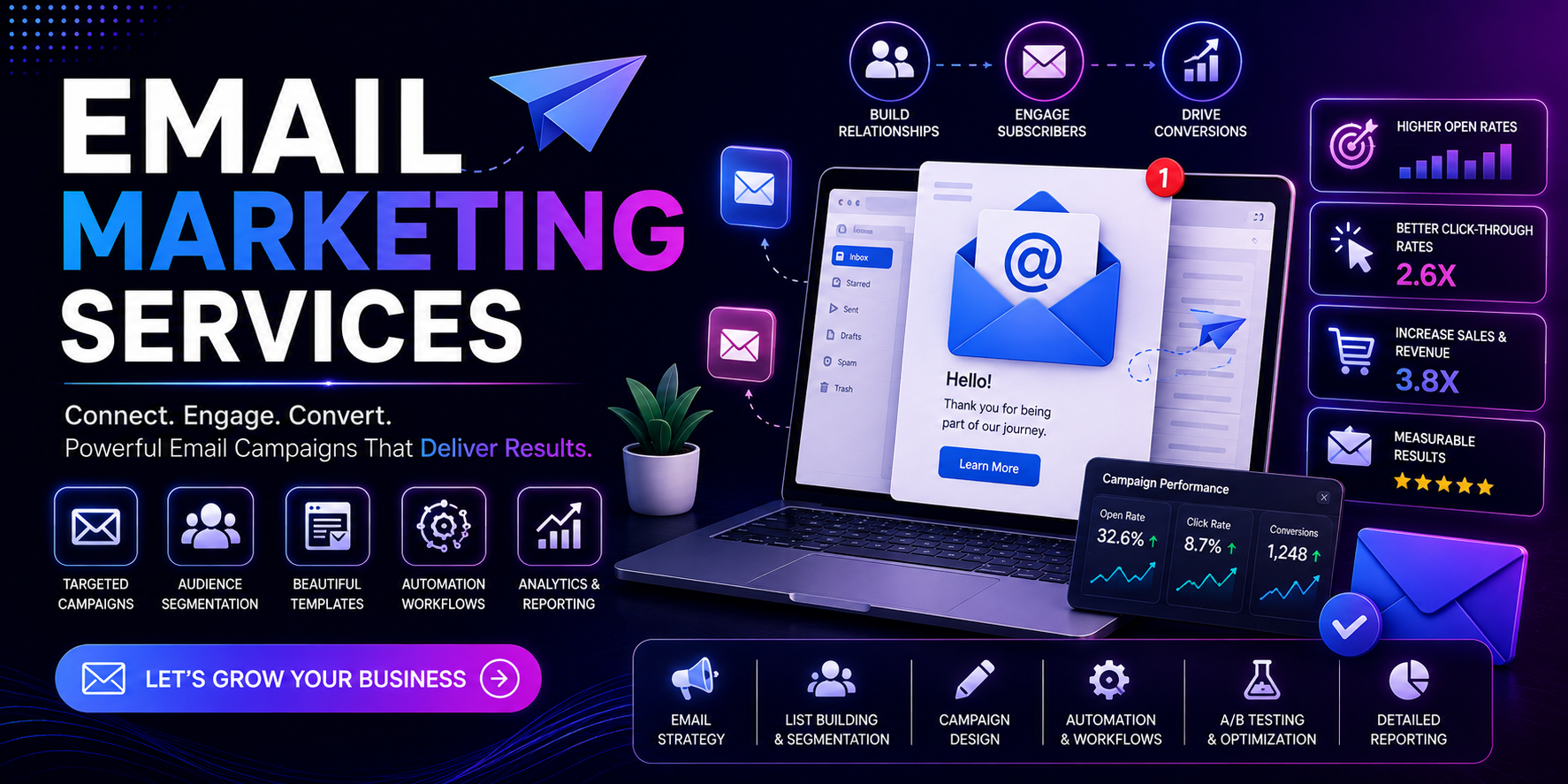
At Technoholic, our Email Marketing Services help your business with the email marketing lifecycle. This includes the planning, creation, management, automation, and optimization of email campaigns. Our email campaigns are customer-centric and focus on achieving your business goals using audience research, content, email design, automation, segmentation, personalization, and performance analysis.
Email marketing is the practice of sending emails to a targeted audience. Email marketing campaigns can include advertisements, informative emails, lead-generating emails, and emails that promote and sell your services. Email marketing helps businesses retain and develop relationships with their customers.
Email marketing can be used to send different types of emails to customers to inform them of new products and services. Email marketing can also be used to provide customers with educational content and can be used to send special offers.
Elements of an effective email marketing plan include:
At Technoholic, we customize email strategies to fit specific audiences, business models, their communication goals, and fit within the customer journey.
For a business to meet prospects and customers where they are, email marketing is the answer. Not all prospects are ready to buy at the moment of their website visit, and email marketing offers a channel for business to sustain their interest through relevant content.
Email marketing is an effective tool for prospects and customers to stay connected to a business even after a purchase has been made, and offers the business a means for ongoing communication to sustain their interest through updates, information and support.
Email marketing is a business tool for:
Email marketing is about staying relevant to your customers. Sending a blanket email to all subscribers is no substitute for sending tailored emails that fit the customer journey.
All businesses, start-ups and eCommerce come with their own unique challenges, and Technoholic provides email marketing solutions that are tailored to meet those challenges.
The first step in any successful email campaign is strategy. Businesses should know their target market and their goals in order to build successful email campaigns. Businesses should also know what content their target market will find the most valuable.
The following elements can be the focus of your email marketing strategy.
Having a detailed email marketing strategy creates email campaigns that align with the goals of the business and the overall marketing strategy.
Every business will have different email campaigns to meet the different goals of the business. Some email campaigns may be designed to increase awareness of a business and its offerings, while other campaigns may have a different goal such as promoting a specific product or service, a business event, or a limited time offer.
Email campaign management will typically include the following.
Having a well-defined goal for each campaign helps ensure the message is relevant and focused.
A business is able to email its subscribers on a regular basis with valuable content to increase customer engagement through newsletters. Valuable newsletters do not serve as a platform for constant advertising.
A newsletter may contain.
Consistent newsletters help businesses engage their subscribers and maintain a relationship with them.
Content quality for emails helps subscribers to comprehend and yield to a campaign. Clarity, brevity, relevance, and intentionality need to be the key elements of every email message.
Email content writing includes:
The brand voice, audience, industry and type of campaign are the elements which dictate the style of writing.
Professionally designed email templates provide a cohesive experience of a brand. With a well designed email template, users can identify the important content and messages are legible when read on any device.
Email template design can provide:
Templates can be built for newsletters, emails for promotions, product announcements, lead nurturing, and any other communications of business which recur.
Due to the high number of users that read emails on their mobile devices, email campaigns should be created with an awareness of the varying screen sizes.
Responsive design emails are focused on the message that you convey.
Key factors include:
Email subscribers, regardless of device, can have a positive email experience.
The success of an email marketing campaign is highly dependent on the subscriber list. Businesses need to efficiently and purposefully manage the collection and segmentation of subscriber data.
Email list management involves:
Companies must build email lists using approved, permission-based methods. They must also follow the applicable email marketing rules and privacy regulations.
Subscribers do not all share the same interests or needs. Businesses must be able to separate their audience into different relevant groups to be able to send communications that are relevant to that group.
Segments can be based on:
As an illustration, an email funnel may be set up so that a new subscriber gets a series of emails designed to provide them the email marketing basics, while an existing customer gets a series of emails designed to provide them company-specific product updates.
Personalized communications move emails closer to individual subscriber relevance, as opposed to treating the entire audience as a single group. Customizations of communication can be based on information a business has.
Some of these customizations may be:
Personalization should move emails closer to individual relevance. Sending a generic email and inserting a subscriber’s name should not be the goal.
Email automation makes it possible for businesses to set up communications to be sent based on specific criteria. A big time saver, this also helps maintain a high level of communication with customers.
An example of this is an automated welcome email that a business may send to new subscribers as the first email of a new email sequence.
Email automation supports many functions, including:
Automation be tailored to a business’s customer journey.
Welcome emails are the first direct communication a subscriber gets as a member of the email list. Welcome emails introduce the brand and explain what new members can expect.
A welcome series can be made up of the following:
Well planned out and written welcome series offers subscribers expectations, and helps build the brand’s relationship with the subscriber.
Leads don’t have to be sales ready right away. Lead nurturing helps a business stay connected to leads and educate them by sending them a series of relevant emails.
Nurture campaigns can have educational content, industry info, case studies, product descriptions, FAQs, and other resources.
Nurturing leads means a business can:
The content and frequency of emails should be appropriate to the audience and customer journey.
Promotional emails center around specific offers, products, services, launches, events, or campaigns. When writing these emails, be sure to highlight the main value proposition without adding fluff.
Promotional emails can assist with:
Promotional communications can be improved with good design elements such as a clear, appropriate, and engaging message with a relevant audience, strong visual hierarchy, and a call to action.
E-commerce companies can sustain customer relationships and develop new ones with email marketing throughout the customer lifecycle.
E-commerce email marketing includes:
Customer lifecycle and email marketing strategy can be based on customer behavior, the purchase cycle, the products the company sells, and the company’s goals.
Subscribers can become inactive to emails even if they were once engaged. Re-engagement campaigns can determine if former email subscribers are still interested in receiving company communications.
Re-engagement campaigns can include:
The focus should be placed on offering former email subscribers a value proposition in order to encourage them to engage the emails. The campaigns cannot be focused on sending emails with repeated offers.
The email marketing strategy is based on the different elements of emails that are tested to determine which version is preferred by the customers. The different elements are:
Testing should be based on a clear objective and a sufficient sample size. The results can be used to guide marketing campaigns.
To remain competitive, it is critical for every business to analyze how each subscriber engages with the business’s email campaign. This analysis will also show the business where email campaign improvements are necessary.
Depending on the campaign and platform, performance analysis may involve:
Analytics identify the content, audience, and format of the campaigns with the greatest engagement.
At Technoholic, we have a consistent method for creating and managing email marketing campaigns.
Email marketing can be customized per industry since respective businesses have unique customer journeys and distinct preferences for communication.
Email marketing can be applied to:
The industry and audience can determine how content will be tailored, how often emails will be sent, what level of automation will be implemented, and how segmentation will be conducted.
Email marketing is a continuous activity that involves strategy and adjustments. Businesses encounter challenges like low engagement, poor list quality, and inconsistent messaging and communication. Subject lines can be ineffective and email campaigns poorly segmented.
Specific challenges include:
A plan can help address the challenges and improve email marketing.
Email marketing integrates seamlessly with other digital marketing practices and does not have to function as a stand-alone channel. Website content, SEO, social media, paid ads, and lead gen form the basis of a holistic email marketing system.
An illustrative instance is using SEO or advertising to attract a website visit, prompting email subscription, email nurture, and steering interested leads to a purchase.
Email marketing can help with:
When combined, marketing channels create a seamless customer journey.
At Technoholic, we know that great email marketing isn’t just about designing great email templates. It requires having the audience, the right message, timing, smart automation, and the ability to analyze results.
Our Email Marketing Services handle the creation of customer and business objective aligned email marketing campaigns.
Technoholic stands out for:
Focus on creating systematic email marketing to facilitate organizations maintain the prospects and customer interest.
Creating systematic and relevant communication with the audience is a key feature of having a professional email marketing service. When combined with a clear email marketing strategy, the content and design of the email along with proper segmentation and analytics, email marketing becomes a key feature of an organizations digital marketing efforts.
The key benefits are:
Email marketing retains the value with building the audience and providing relevant communication over only a single campaign per email.
Using email marketing services, businesses can implement direct, meaningful, and measurable email marketing campaigns. Services that support the development of newsletters and promotional campaigns, as well as lead nurturing, personalization, segmentation, automation, and reporting, help businesses manage the various stages of the customer journey.
Email marketing is most effective when the business understands its audience and is able to send the most relevant message at the perfect time. Subscribers should be understood, the information should be valuable, the lists should be organized and segmentation should be utilized. Furthermore, businesses should be committed to analyzing their marketing campaigns.
Technoholic blends strategy, content, and design with segmentation and personalization, and automation and analytics to offer tailor-made email marketing services. Technoholic combines its email marketing services with the supporting framework to help businesses meet their marketing and business goals.
From newsletter management, promotional campaigns, and lead nurturing to e-commerce email marketing, and responsive email templates, as well as the development of a comprehensive email marketing strategy, Technoholic offer systems that engage customers and help grow businesses.