Every business runs on some kind of technology now — for managing operations, talking to customers, processing data, or just automating the stuff nobody wants to do manually. But as a business grows, its processes tend to get messier and more specific, and off-the-shelf software just doesn’t always keep up. That’s usually the point where a business realizes it needs something built specifically for how it actually works, not something it has to bend around.
Software development sounds like it’s just “writing code,” but honestly that’s a small part of it. It’s understanding what the business actually needs, planning out the architecture, designing interfaces people will actually enjoy using, building the functionality, wiring up databases and APIs, testing it properly, deploying it, and then — this part gets skipped a lot — maintaining it once it’s live.
At Technoholic, we build software that’s reliable, secure, and genuinely usable, and we adjust our approach depending on whether we’re working with a two-person startup or a company running multiple departments. There’s no single template we stretch to fit everyone.
Custom business tools, enterprise systems, SaaS products, CRMs, ERPs, workflow automation, web apps, integrations — whatever the requirement actually is, that’s what we build toward.
At its core, it’s the whole journey — planning, designing, building, testing, deploying, and keeping something running long after launch.
Software gets built for all kinds of reasons: managing a business, serving customers better, automating repetitive work, handling data, tracking sales, running operations, generating reports, or just building a digital product from scratch.
A typical project touches requirement analysis, architecture decisions, UI/UX design, frontend and backend development, database work, API development, integrations with other tools, security, testing, deployment, and ongoing maintenance. How deep each of these goes really depends on what the software is for, who’s using it, how complex it needs to be, and how much room it needs to grow into later.
No two businesses run exactly the same way, even in the same industry. Generic software can handle the basics fine, but the moment your workflow gets a little specific — and most businesses’ workflows do — it starts falling short.
Custom development flips that problem around. Instead of changing how your team works to match some software’s assumptions, you build the software around how your team already operates.
That usually means automating the repetitive stuff people are tired of doing by hand, tightening up internal workflows, pulling scattered data into one place, connecting systems that currently don’t talk to each other, cutting down manual work, and giving you actual visibility into what’s happening across the business. It also means you’re not stuck — the software can grow as your business does, instead of becoming the thing holding you back.
We work across the board — startups building their first product, small businesses replacing spreadsheets with real systems, and larger companies that need something more structured.
Custom software. Built entirely around your business — internal tools, customer portals, employee apps, reporting dashboards, automation systems. Sometimes we design around your existing process, sometimes the goal is actually to improve that process along the way.
Web-based software. Accessible from a browser, no installs required, usable on a laptop or a phone equally well. This covers everything from SaaS products and dashboards to booking systems, project management tools, and internal utilities — and it makes central management a lot easier since there’s one version everyone’s using.
Enterprise software. Bigger organizations usually need something that works across multiple departments, user roles, and locations at once — employee management, operations, inventory, finance, customer data, reporting, all connected. This kind of build needs real planning up front around security, permissions, and how it’ll scale, because retrofitting that stuff later is painful.
SaaS platforms. If you’re building a product customers subscribe to and access online, that means user registration, account and subscription management, dashboards, role-based access, billing, notifications, and usually an admin panel behind it all. Scalability and security aren’t optional here — they’re the whole point.
Business management software. A lot of companies are juggling five different tools to manage customers, staff, tasks, sales, inventory, billing, and reporting. We can bring all of that into one platform, built around modules that actually match what your business needs — not a bloated system full of features you’ll never touch.
CRM development. Custom CRMs handle lead tracking, customer profiles, sales pipelines, follow-ups, task management, and communication history — and they can plug directly into your website, forms, email platform, and marketing tools instead of living as a disconnected system.
ERP development. ERP requirements genuinely vary a lot by industry, so this gets built around your specific operational reality — inventory, sales, purchasing, accounting workflows, employee processes, order management, reporting — rather than a one-size-fits-all system.
Workflow automation. If your team spends hours every week on repetitive manual tasks, automation can move information between stages without anyone touching it — lead assignment, notifications, approvals, syncing data, order processing, report generation. The tricky part is mapping out the business rules and edge cases properly, because automation that misses exceptions creates more problems than it solves.
Inventory management software. For businesses dealing with physical stock, this covers product tracking, warehouse management, stock adjustments, purchase and sales records, and low-stock alerts — and it connects well with e-commerce sites, ERP systems, and POS setups.
Project management tools. Projects, tasks, team assignments, deadlines, status tracking, comments, files, notifications, reporting — built around however your team actually manages work, not a rigid methodology imposed from outside.
Customer portals. A dedicated space where customers can check orders, download invoices, raise support requests, book appointments, or track service status — which, honestly, cuts down a surprising amount of routine support traffic.
Employee management software. Profiles, attendance, leave requests, tasks, departments, documents, internal communication, reporting — shaped around how your internal operations actually run.
APIs. APIs are what let your software talk to everything else — mobile apps, websites, CRMs, ERPs, payment gateways, third-party services. A properly designed API makes connecting different parts of your digital setup a lot less painful later on.
Third-party integrations. Most businesses already depend on external platforms for specific jobs — payments, CRM, ERP, email, SMS, accounting, cloud services, marketing tools, analytics. We integrate with these through APIs or whatever method the platform supports.
Database development. Almost every piece of business software leans on a database underneath. That means proper architecture, data models, relationships, validation, query optimization, security, and backup planning — get this wrong early and performance problems show up later, usually at the worst time.
UI/UX design. Software with a dozen screens, dashboards, forms, and reports can get overwhelming fast if the interface isn’t thought through. User flows, wireframes, dashboard layout, navigation, forms, tables, notifications — all designed around who’s actually using it and how complex their job already is.
Security. This matters even more when software’s handling customer data, employee records, or financial information. Authentication, authorization, role-based access, input validation, secure API communication, session management, security testing — and honestly, this needs to be planned from day one, not bolted on right before launch.
Testing. Functional, integration, UI, API, performance, security, compatibility, regression, user acceptance — how much of this actually happens depends on how complex the software is and how much is riding on it working correctly.
Performance optimization. As software grows, slow dashboards and inefficient queries start costing real time and patience. Database tuning, API optimization, caching, cleaner queries, resource management, and ongoing monitoring keep things running the way they should as usage scales up.
Cloud-based development. Hosting on cloud infrastructure gives you remote access, scalable resources, centralized data, and easier deployment and backup — the right setup depends on your security needs, expected usage, and operational requirements.
Legacy modernization. A lot of businesses are still running on older systems that are painful to maintain or won’t integrate with anything modern. We can modernize this incrementally — architecture improvements, database migration, new APIs, interface updates, cloud migration — instead of forcing a risky full rebuild all at once.
Migration services. Moving applications, databases, or entire platforms needs careful planning around data migration, testing, and deployment timing, so you’re not looking at data loss or unexpected downtime partway through.
Maintenance & support. Software isn’t a one-time build — requirements shift, APIs change, security needs evolve. Ongoing maintenance covers bug fixes, security updates, performance tuning, new features, API updates, database upkeep, and general monitoring so the system keeps pace with the business instead of falling behind it.
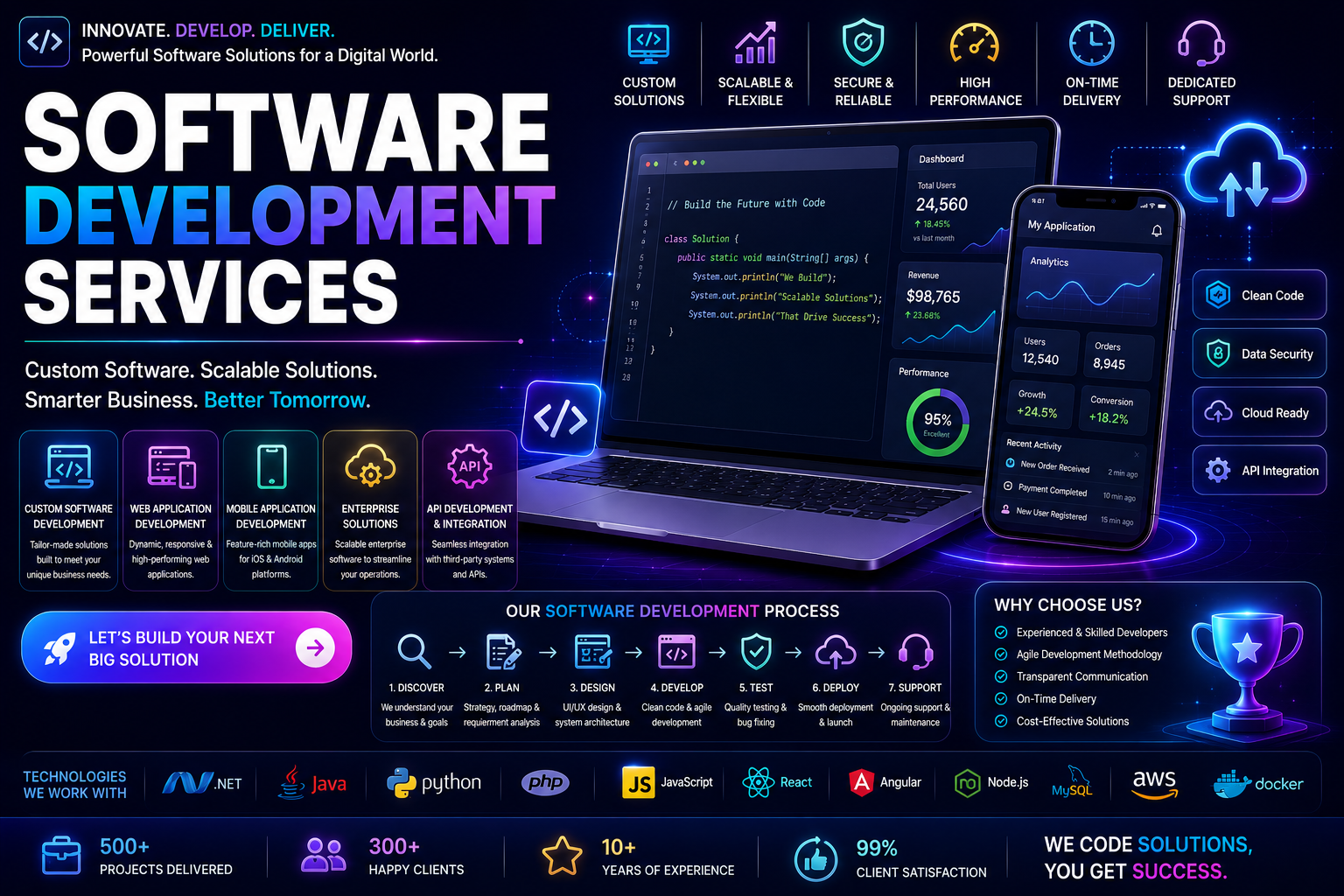
We start by understanding the business — the goals, the users, the workflows, the pain points, and what’s technically required. From there we plan out the modules, user roles, tech stack, database structure, and development priorities before any code gets written.
Design comes next — interfaces, navigation, dashboards, forms — followed by the architecture decisions around database, APIs, security, and how the system needs to scale. Then actual development happens: frontend, backend, database, and functionality, all built against that approved plan.
Once the core is built, we integrate whatever external systems are needed — payment gateways, CRM, ERP, cloud services — and test everything thoroughly before it goes anywhere near production. After deployment, we keep monitoring for performance issues or bugs, and ongoing maintenance keeps the software evolving as your business does.
E-commerce, education, healthcare, real estate, logistics, manufacturing, retail, finance-related businesses, professional services, digital marketing, hospitality, travel, startups, and larger enterprise organizations. What we build shifts a lot depending on the industry, but the thinking behind it — build for the actual process, not an assumed one — stays consistent.
Requirements that aren’t fully clear at the start. Workflows that are more complicated than they first appear. Integrations that don’t cooperate the way documentation promises. Security requirements that need to be baked in early. Performance issues that only show up under real load. Scalability questions nobody thought through until traffic actually increased. Data migration headaches. Third-party APIs changing without much warning. Getting your own team to actually adopt the new system. None of this is unusual — it’s just what real software projects run into, and it’s exactly why upfront planning, clear documentation, proper testing, and honest communication matter as much as they do.
We build software around what a business actually needs — not generic functionality dressed up to look custom. That covers custom software, web-based platforms, enterprise systems, SaaS products, CRM and ERP builds, business management tools, workflow automation, inventory systems, project management tools, customer portals, employee systems, API development, integrations, database work, UI/UX, security, testing, cloud deployment, migrations, legacy modernization, and support that continues after launch. We work with businesses at every stage — from a startup building its very first product to an established company modernizing something that’s been running for a decade.
Functionality that’s built around how you work, not the other way around. Real process automation. Data that lives in one place instead of scattered across five tools. Better workflow visibility. Systems that actually talk to each other. Less manual grunt work. Architecture that scales instead of needing a redo every year. Custom permissions that match your team’s structure. Reporting you can actually act on. And more flexibility to change things as the business changes.
To be fair, how much value you get out of any of this still depends on how it’s implemented, how your team adopts it, and whether the underlying strategy makes sense — the software itself is the tool, not a guarantee.
Digital transformation, at its heart, is just replacing disconnected manual processes with systems that actually work together. A business might connect its website, mobile app, CRM, ERP, inventory system, payment gateway, support tools, and analytics — and through APIs and shared architecture, all of that starts exchanging information instead of living in separate silos.
Software development that’s done properly goes well beyond writing code. It’s requirement analysis, architecture planning, thoughtful UI/UX, solid database work, frontend and backend development, API integration, real security, proper testing, careful deployment, performance tuning, and maintenance that doesn’t stop the day the project “launches.”
That’s the full scope of what Technoholic covers — from planning through to long-term support — whether you’re a startup building your first product, a growing company trying to automate what’s currently manual, or an enterprise looking to modernize systems that have outlived their usefulness. Let’s figure out what that actually looks like for you.