
Mobile applications have revolutionized how businesses engage with customers, employees, partners, and digital tools. Whether it is shopping, banking, education, health, entertainment, communication, logistic, or management apps, mobile applications allow users to perform a variety of tasks and engage with offerings, services, and processes of businesses.
Ease of use, performance, flexible user experience, and intuitive design are the needs of a successful mobile application. Technoholic’s mobile application development services create customized mobile applications that meet your business requirements and enhance customer engagement.
Our mobile application development services include:
Technoholic offers mobile application solutions for:
Mobile application development refers to design and development of applications to be installed on mobile devices to perform a particular task.
An app can be developed for every major platform and to meet individual business needs. Development may involve native technologies, cross-platform frameworks, back end APIs, databases, cloud services, payment systems, notifications, analytics, and third-party integrations.
Relevant technologies and architectures depend on the application features, the user base, projected usage, budget, performance needs, and planned expansion.
Performing mobile application development increases accessibility of businesses offerings and services. This is particularly the case for applications that either provide tools or information that is necessary for a user to frequently interact or engage with a business.
Mobile applications can also:
Technoholic provides complete services for mobile app development which include planning, UI/UX design, development, integration, testing, deployment and maintenance.
Android Apps help businesses reach their customers with applications that run on devices of all shapes and sizes.
Development of Android apps includes:
Applications are developed in accordance with the desired functionalities, consideration of devices, user interface, backend architecture and business requirements.
iOS app development provides businesses with the ability to build digital products for the Apple mobile ecosystem.
iOS app development requires:
The design and development process can be optimized for the intended iPhone and iPad experience where applicable.
Cross-platform development is useful when businesses need multiple mobile apps. Developers can use a cross-platform approach to build apps that run on several supported platforms with a large code base shared across apps.
Cross-platform development allows for:
Cross-platform development is appropriate when the desired application’s functionalities, performance, device-specific features, and the long-term technical direction are considered.
Every business has its unique needs. A standard application can potentially lack the functionalities that can fully address the needs of a specific business process.
Custom mobile app development empowers a business to create applications that support and fulfill the functionalities and needs of its customers.
Custom mobile development can include:
Design and development can align with the needs of the project.
Since mobile devices have smaller screens than their desktop counterparts, mobile design has its own set of constraints for UI/UX design principles. If your app’s mobile design is clunky or hard to navigate, it can cause users to disengage and lose interest.
Designing great mobile UIs can incorporate:
Our approach is to utilize our design experience to make mobile interfaces visually consistent and practical.
In today’s world of shopping and selling, it is essential to have mobile apps that allow customers to check out on the go, browse your catalog, or manage their accounts.
E-Commerce mobile apps can offer:
An app can be integrated with other e-commerce systems such as shopping platforms, APIs, and payment services.
Startups need to launch products and services quickly to be the first in the market, but their architectures also need to be flexible as the products gain market traction. A great mobile app can give a startup the ability to test the market and create early stage product market fit.
The development of a app can include:
An MVP approach can help you understand if your product design will resonate with your future customers and can inform next steps without spending heavily to add advanced features to your app.
Umbrella businesses usually need mobile apps for staff, clientele, stakeholders, or to enhance their business processes.
Enterprise mobile applications can be used for:
The development of enterprise applications requires additional consideration for security, access controls, integrations, scalability and suitability for organizational workflows.
On-demand mobile apps facilitate the delivery of services to customers.
Examples include:
On-demand mobile apps may need status notifications, GPS, reminders, booking requests, payments, and customer reviews.
Businesses that operate on bookings or appointments can use mobile applications to help manage bookings.
Booking apps can provide:
This can be useful for education, medical services, beauty, fitness, travel services, and other businesses that depend on appointments.
A mobile application requires a system to manage and store data. APIs provide a connection between a mobile application and backend services.
Backend development can include:
API development can provide a mobile application with the ability to communicate with other CRM, ERP, e-commerce, payment, and other business systems.
Mobile applications that support transactions require payment gateway integration. Payment integration must be done with care to ensure secure and efficient transactions.
Payment integration includes the following:
The payment methods and integration frameworks are dependent on the payment provider and the project requirements.
Push notifications help applications notify their users of information even outside of the application.
Notifications can be used for:
The aim of a notification system is to ensure users are notified of important information without being bombarded.
Location related services depending on geographic data help applications to provide services to their users.
Location-related services can help with:
This kind of functionality must be used with concern for the accuracy, and platform requirements as well as the privacy and permission settings.
User authentication is a mobile application must have to protect user information of personal accounts.
Authentication can include:
The authentication system can be designed based on the application’s requirements of protection.
The security of mobile applications is very important. Especially when applications process customer data, payment data, business data, or authentication data.
Mobile app security includes:
Security requirements for an application are dependent on the application’s functionality, data, users, and the industry.
Mobile applications must work on various devices, multiple operating system versions, different screen sizes, and diverse network infrastructures.
Testing involves:
Identifying issues and solving them before the application is released is important.
impact of mobile application performance on user satisfaction.
Impact of slow loading, application crashes, high battery consumption, and unresponsive applications is high.
Optimizing performance involves:
Mobile app performance optimization strategies are dependent on the design and functionality of the application.
Integrating mobile application analytics helps business owners evaluate the interaction of their users with the application.
Analytics helps answer:
Analytics helps business identify over/under used features and the improvement areas on the application.
Mobile app development continues after the application is launched.
Mobile operating systems, devices, third-party services, and the requirements of security change over time.
Mobile App Analytics helps business deal with the changing requirements of security and third-party services.
App maintenance regularly covers the following:
Regular maintenance will keep an app functioning and updated with technology.
Once an application has undergone development and testing, the app is distributed to the relevant app store.
To accomplish deployment, these steps are taken:
Before publication, an app must satisfy the current technical and policy standards of the relevant app store.
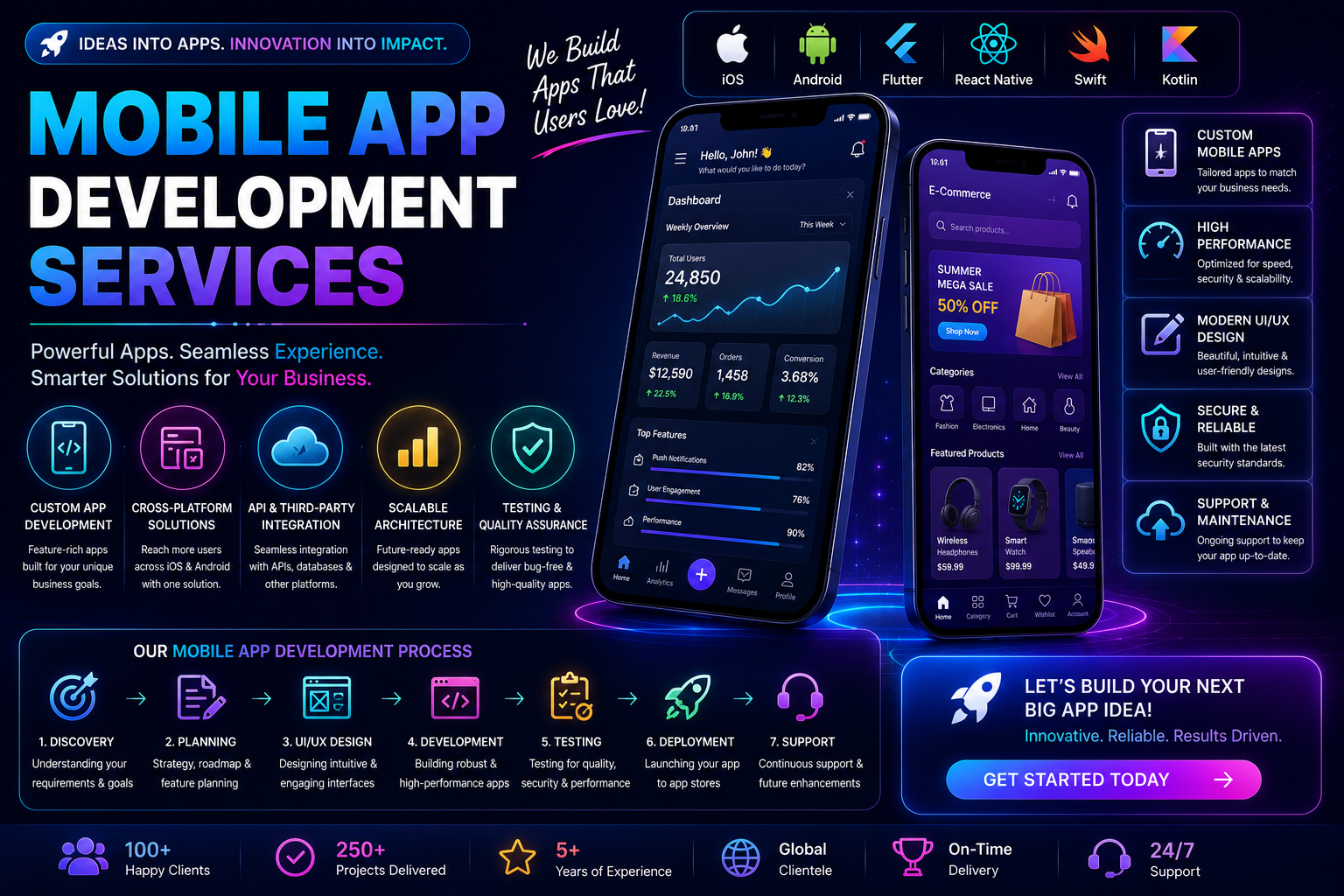
To develop a mobile application, we follow the procedure outlined below:
Identifying the client’s needs and understanding their business anduser needs enables us to define the functionalities of the application.
Based on the functionalities and the user requirements, a workflow is established. User roles and integrations are identified. The architecture, design and the development sequence is finalized.
Based on the requirements of the application, we design the user interface and create user flows, wireframes, and screens.
Based on the decided architecture, we determine the required development technology.
Based on the business logic, we develop the backend, and if needed, the databases, and APIs.
Once the system is built, we develop and implement designs and integrate the required payments and third-party services.
APIs, payment gateways, and other third-party services and integrations are added.
The application is tested across various devices, OS, screen sizes, network conditions, and user flows.
The application is prepared and uploaded to the appropriate app stores.
Following publication, the application remains under our responsibility for bug fixes, updates, performance and security improvement, and the addition of new features.
Mobile App Development can be used for multiple business models and industries.
Technoholic can develop mobile apps for the following:
The design and architecture are developed as per the particular requirements for each project.
Creating a successful mobile app involves planning and a lot of testing. Most problems that occur are:
A phased development process addresses all the challenges described earlier.
With Technoholic, you can expect practical applications with an emphasis on design, usability, technical reliability, and scalability.
Our Mobile App Development Services provide:
We prefer to be flexible in our approach to accommodate project needs.
Developing mobile applications offers businesses a dedicated channel to interact with their customers and manage their services.
Advantages include the potential for:
The actual business outcome is determined by the quality of the application, demand, user adoption, business model, marketing, the strategy employed, and the overall experience of customers.
Mobile Apps can connect and integrate with various components of the digital business ecosystem. These include websites, APIs, CRM, and ERP systems, payment gateways, analytics, and marketing APIs.
Additionally, a Mobile App can connect to:
This integrated ecosystem can provide a business with the ability to deliver a more unified digital experience across a variety of interaction touchpoints.
Mobile App Development Services turn ideas, products, and services into apps for modern day users. With the help of technology, mobile apps provide businesses with different ways to offer digital services and engage users. This can be in the form of an Android or iOS app, cross-platform, e-commerce, enterprise apps, booking services, and/or on-demand services.
Creating a mobile application is more than just coding. It encompasses planning and creating a product, requirement analysis, UI/UX design, API integration, testing, security, optimization, deployment, and the subsequent maintenance.
At Technoholic, our Mobile App Development Services offer solutions that support the entire development life cycle, from designing a UI/UX that meets your specific requirements to API integration, testing, deployment, and continued maintenance.
Whether you are an e-commerce business looking to create a mobile shopping application or a large enterprise wanting to create an internal service app, we can help you build the mobile application that will meet your long-term digital service goals and help you scale and focus on business.