
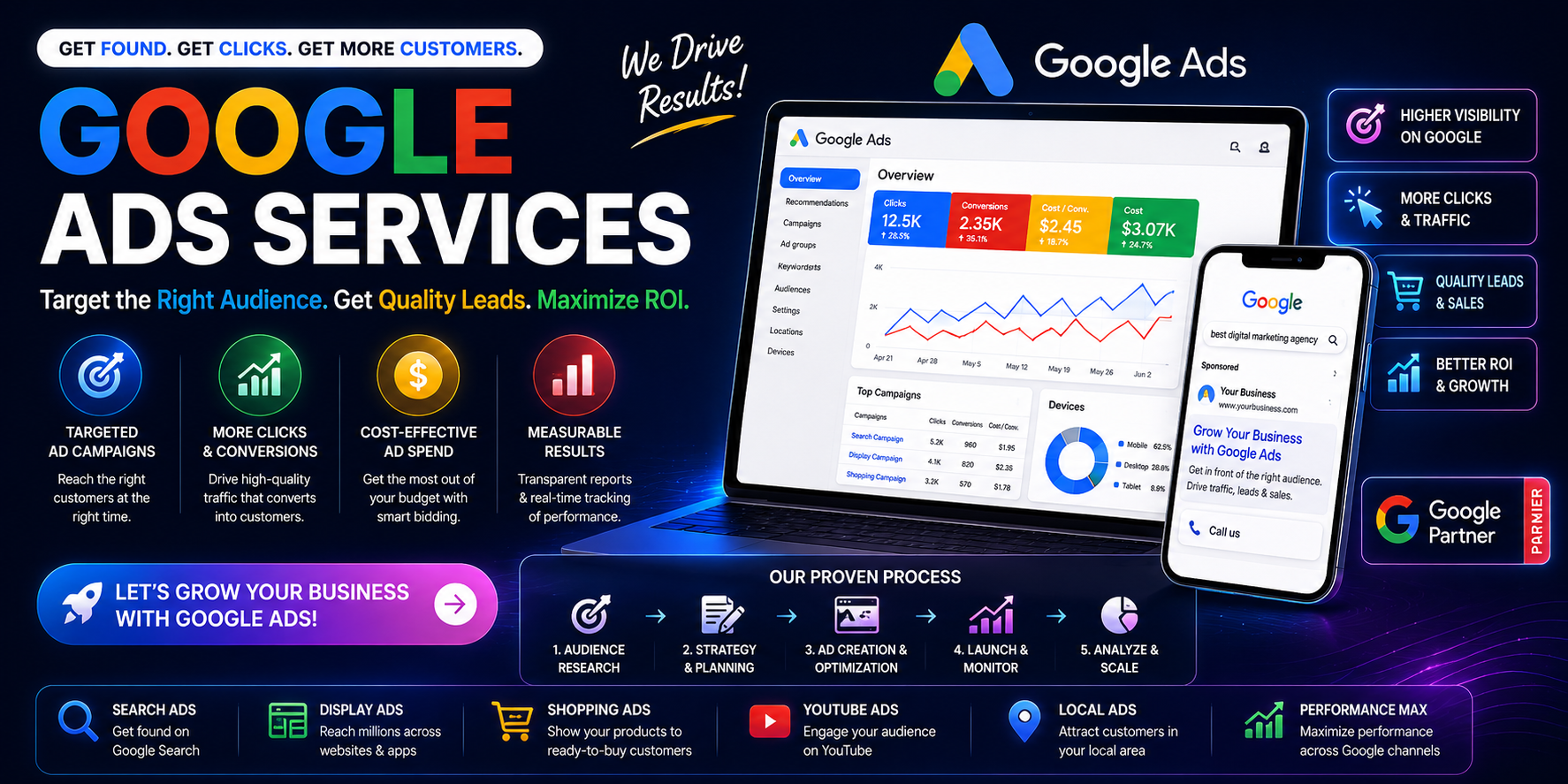
Find high value customers at the most optimal times and locations using our Google Ads Services, and watch your business grow. As potential customers search for goods and services on search engines, businesses must be present at that given moment. Google Ads Services provide businesses with an opportunity to appear in front of their relevant audience through paid search advertising across Google’s Advertising ecosystem.
Google Ads can be used to achieve numerous marketing goals, including lead generation, increasing website traffic, promotion of goods and services, increases in sales, creation of brand awareness, and target marketing to potential customers based on search intent.
At Technoholic, we offer Google Ads Services to plan, execute, maintain, and optimize paid search advertising. We combine numerous elements of search advertising, including keyword research, campaign strategy, target audience, ad and landing page copy, ad optimization, budget allocation, and performance advertising to develop campaigns based on marketing goals.
Google Ads is Google’s official advertising network where businesses can place advertisements across Google search, Google Display Network (GDN), and Google partner sites to promote goods and services. Campaign creation can be made based on the objectives of driving sales, creating leads, increasing website traffic, and more.
Google Ads offers:
The appropriate campaign type depends on a company’s business model, audience, products and services, budget, and marketing objectives.
One of the strengths of Google Ads is the ability to connect a business to users that are interested in the product or service and possibly are ready, or almost ready, to make a purchase. For example, a potential customer searching for a given service is more likely to make a purchase over a potential customer that has never engaged with the business.
Therefore, paid search is ideally fits businesses that want to gain visibility for specific products or services that they want to market.
Google Ads can give businesses:
The outcome of advertising is determined by competitors, keywords, quality of offered products and services, page experience, budget, targeting, and campaign management.
At Technoholic, we provide customized Google Ads solutions designed around each business’ unique needs. We develop campaigns around a structure that allows for monitoring, testing, and optimization based on meaningful performance metrics.
The foundation of a strong advertising strategy is the analysis of the business and its customers. Prior to launching a campaign, we study the offered product or service, the intended audience, the geographic market, the competition, the customer journey, and the desired conversion.
Our Google Ads strategy might include:
A strong strategy ensures that businesses achieve their goals with their advertising dollars.
Search ads are Google ads that appear when someone searches for a keyword relevant to your ad. These are great for targeting keyword searches with search advertising intent.
An example is the keyword query “software development company.” This user is clearly in the market for developing software. A search ad can put a software development company in front of this user when they are searching for potential companies.
Campaigns can include:
The goal is to align the user search, ad, and landing page as closely as possible.
Display campaign ads allow visibility on the Google display network. These take a visual ad format that is posted across Google’s ad network.
These ads work best for brand awareness and campaigns that are focused on a specific promotion.
Display campaigns work well to support customer journeys.
Google Shopping campaigns grant e-commerce businesses rich advertising opportunities to display product info alongside an image, name, price, and other relevant product information.
Shopping ads allow a business to advertise various things, including:
Advertising products on Shopping alone does not result in a successful Shopping campaign. Campaigns might fail if there are issues with data quality, campaign structure, performance of landing pages, pricing, inventory, website experience, etc.
Video ads also provide an opportunity to advertise products. Advertised videos can be used to introduce products/services, demonstrate products, tell a brand’s story, sell, or explain a service.
Video ads can be used for campaigns that aim to:
Any video ad should be designed according to the campaign’s objective and the type of audience that will be viewing it.
Google has several campaign types aimed at helping businesses achieve various performance and conversion goals on its platform.
Automation and signals used by Google can help reach potential customers based on the given campaign goals.
These types of campaigns can be used to achieve the following:
Well performed ads can utilize high quality creative content, audience signaling, optimized tracking, great landing pages, and require continual optimization.
Keyword research is a vital part of search advertising and is used to find the terms that customers search to find a business’s products or services.
Keywords are usually grouped under different types of intent such as informational, investigational, and transactional.
The aim is to find keywords that are relevant to a business rather than ones with the highest search volume.
Understanding search intent means knowing what a user intends by using specific search terms.
Search intent can be about:
When users find what they need, it’s helpful to match relevant ads to search intent.
Not all searches that relate to a keyword have business value to a business. Negative keywords can help eliminate ads from showing up for searches that are irrelevant or of no business value.
Negative keyword management helps with:
Negative keyword strategies have to be flexible and be changed when new search-query data is available.
Advertisements have to be highly specific because they need to attract a potential customer’s attention while trying to communicate the value of a product or service within a short space.
Google Ads can have:
To satisfy user expectation, consistency of the ad with the landing page is key.
Some campaigns can end upon ad click. Yet, the experience a visitor has upon reaching the landing page can determine whether that visitor performs the intended action.
Landing page optimization can include:
Landing pages should reflect the ad they are directing traffic to.
Google Ads allow businesses to target specific areas. Businesses that provide local services can use local advertising to reach users searching for the service in which they offer.
Local campaign strategies can include:
Local conversion tracking should be set to the location of the business where products and services are offered.
Most site visitors do not convert on the first visit. Remarketing is meant to target site visitors who previously engaged with a business’s site or ads.
Remarketing can target:
Remarketing should always comply with applicable privacy protection laws and platform policies.
Measuring campaign effectiveness is impossible without conversion tracking. Conversion tracking helps determine which campaigns, audiences, ads, and keywords have the most impact.
Conversions can be defined as website visits where a transaction, contact, booking, or form is completed.
Conversions for website visitors may look like:
Understanding conversions at the campaign level for a company can drive advertising decisions based on business goals rather than purely number of campaign clicks.
For Google Ads, budget management means setting budgets related to business goals and competition, based on the price customers are willing to pay and the financial resources available.
Budget management practices may include:
The right budget depends on both the market competition and a business’ ability to convert paid traffic into customers.
Testing in Google Ads is important to help with optimization of campaigns. Identical audience targeting may produce varying results when comparing advertisements, keywords, landing pages, and types of messages.
Testing may involve:
Testing across variables can help a business optimize campaigns based on real world data.
Optimizing a Google Ads campaign means checking campaign performance regularly. There are many factors that may affect campaign performance over time such as competition, search behavior, conversions, costs, and demand.
Optimization may involve:
The goals is to align campaign performance continuously with business goals.
The goal of most service-based businesses is lead generation. Service-based businesses prompt leads to reach out for a consultation, submit a form, request a quote, sign up for a demo, or book a callback. Request services, inquiries for an appointment, or other similar actions.
The quality of leads is determined by the quality of the campaign’s landing page, the offer, audience, targeting, and the follow-up process.
Service-based businesses can also use Google Ads to reach prospects searching for their services and who are ready to make a purchase.
The following can be accomplished with Google Ads for service-based businesses:
Campaigns for service-based businesses should focus on the service, location, and the customer’s needs and desired actions.
Google Ads also enables service-based businesses to build brand visibility. Businesses interested in lead generation can develop campaigns that help potential clients learn more about the business, its products, and/or services.
Service-based businesses prompt leads to reach out for a consultation, submit a form, request a quote, sign up for a demo, or book a callback. Request services, inquiries for an appointment, or other similar actions.
Examples include:
Campaigns can be structured around service, location, customer needs, and conversion actions.
Although Google Ads is primarily considered a channel for driving direct conversions, it is also effective for creating brand awareness. Businesses can use different types of campaigns to build awareness of their brand, products, or services in the marketplace.
Brand-centric advertising helps companies execute the following:
Brand campaigns complement search, SEO, social media and content marketing.
The Google Ads management process at Technoholic involves certain steps.
Jack comes to us and tells us he sells kites and wants to sell them better. We want to understand his business and needs and ask him questions about his ideal customers, locations, competition, and what he sells and where he currently sells it. We want to understand his website and what he wants to achieve.
Based on what Jack wants to achieve from this campaign and what he sells, we determine relevant keywords, research the audience, a location, campaign goals, and advertising possibilities.
Campaigns are created based on audiences, locations, and objectives. Ad groups are organized based on audience, location, and the conversion goal.
Our creative team makes copies that highlight the unique selling proposition and describes the benefits of the product in order to make the users take the desired goal of the campaign.
We review the landing page to make sure that the advertisement and the destination of the ad create a consistent experience for the user.
Tracking of the most important conversions for the campaign is reviewed and implemented. We install tracking to determine the most important actions and possible campaign optimizations.
Setting up targeting, keywords, campaign budgets, ads, and settings of the campaigns refers to their implementation.
Monitoring of the campaigns determines search behavior, trends, and ways to optimize the campaign to improve conversions.
Advertising budgets, keywords, ads, landing pages, and other campaign elements are optimized.
Campaign reports include traffic, conversions, campaign expenditures, and performance of campaigns for the time period for which the campaign ran.
Metrics vary based on objectives, and in the case of lead generation or a campaign whose objective is to increase brand awareness, the metrics will be completely different.
For either objective, the following metrics would be useful:
The more useful or applicable approach is to relate advertising metrics to actual metrics in the business.
Pay per click services can get competitive especially in high bidding markets. Several factors can negatively affect campaign performance like poor campaign landing pages, irrelevant campaign keywords, weak campaign advertisements, inadequate tracking, and poor budget allocation.
These issues tend to affect most advertisers:
To tackle these issues, most advertisers employ best practices like regular campaign management and optimization.
Our experience and understanding of Google Ads allow us to employ the necessary tactics of strategy, research, advertising, creative, technical tracking, and optimization.
We are much more than a click generation service. We improve the advertising value for the business.
Technoholic offers services for:
We formulate strategies for Google Ads based on the Business model, Target Customer, Market, Budget and Desired Campaign Outcomes.
Professional Google Ads Management empowers businesses to create more defined advertising Campaigns and make informed decisions based on the data.
Additional benefits include:
Performance of advertising campaigns is dependent on a number of factors including competition, industry, budget, keyword demand, offer, quality of the website, the conversion process and campaign management.
Google Ads can be a powerful tool if used in combination with other digital marketing services. Paid search has the potential to capture users with high intent, whereas other digital marketing services can build long-term visibility in the organic search results.
Likewise, social media advertising, email marketing and conversion optimization can improve the performance of your digital marketing efforts.
Google Ads can be used with:
An integrated digital marketing strategy can assist businesses reaching customers at every stage of the buying process.
Businesses are able to reach their customers using targeted ads from the Google Ads platform. Google Ads has a suite of advertising products including Search Ads, Display Ads, Shopping, Video, remarketing, lead generation, and performance-centric ad groups. Google Ads encompasses these and many other marketing objectives.
There’s a lot more to a successful Google Ads campaign than choosing a few keywords and setting a budget. It requires a well articulated business strategy, accurate targeting, creative campaign ads, strategically built landing pages with clear defined conversion goals, continual testing frameworks, and dedicated campaign management.
At Technoholic, we offer our clients a full suite of Google Ads Services that include strategy, keyword research, campaign setup, ad copywriting, landing page optimization, conversion tracking, budget management, continual testing and optimization, and reporting.
Whether you are a locally based service business that is looking to capture quality leads, an online e-commerce store wanting to sell more products, or a business that wants to improve its presence, Technoholic can develop a strategic Google Ads plan focused on your business aspirations and audience.