
Customers nowadays spend a lot of time researching products, services, and options. Unlike before, customers don’t simply make purchases. Now they take time to compare, review, and extensively research. It’s vital for companies to have a strong digital marketing strategy that incorporates valuable and relevant content to address this need.
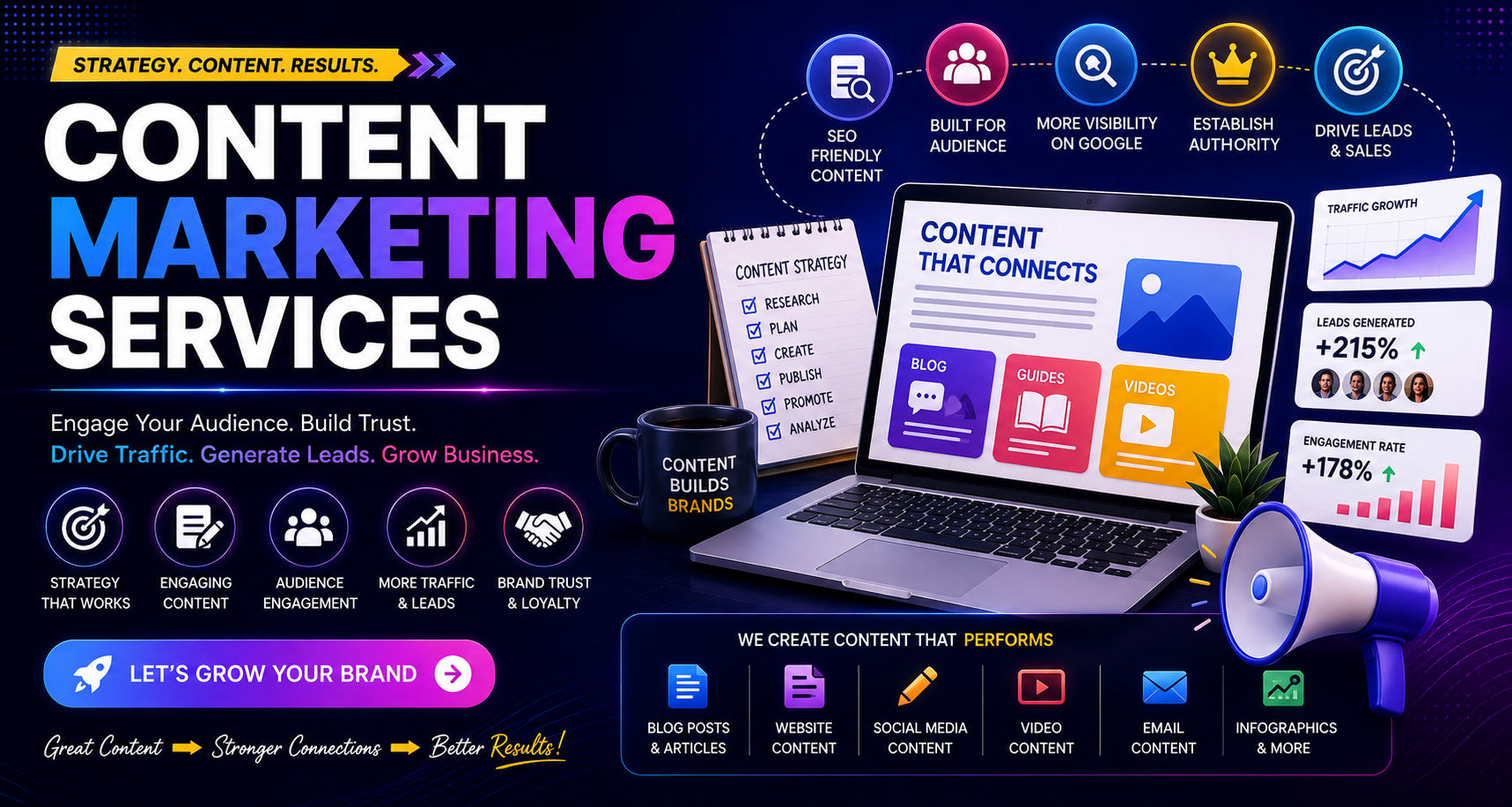
Content Marketing Services enable companies to provide products and services that are relevant to their target audience, while simultaneously meeting their business objectives. Content marketing focuses on the publication of informative materials that help the customer and, in turn, helps build trust.
Technoholic helps companies develop, implement, and sustain effective content marketing strategies with our Content Marketing Services. We engage in audience research prior to undertaking content development and marketing services aimed at helping our clients meet their short and long-term business growth goals.
Our Content Marketing Services include the creation of marketing content following planned audience research. We distribute the content and undertake marketing campaigns as well as measure and analyze the impact of our marketing campaigns.
Content marketing is the publication of research appropriate information to support the slow, gradual growth of the brand and build trust. The end goal is to drive interpersonal interaction between the customer and the business.
Content marketing encompasses a brand’s entire customer journey. A person may stumble upon a brand’s informational blog for the first time, while another customer may peruse a service guide before reaching out to a company.
Content marketing encompasses a variety of formats, including:
The most effective type of content marketing strategy is unique to each business, industry, audience, and desired outcome.
Content marketing is crucial to a business’s success. Customers do not make a buying decision the moment they interact with a product or service for the first time. Customers need to be armed with information to feel confident enough to make a buying decision. Content marketing is the best answer to this information gap.
Content marketing helps:
Content marketing is more than just writing articles. It is strategically providing the right content to the right customer at the right step in the buying process.
Technoholic provides holistic Content Marketing Services based on individual business needs. We aim to create content that serves a purpose and complements a business’ digital marketing goals.
The first step in effective Content Marketing is the development of a strategy. Businesses have to identify their clientele, the info gaps, the relevant topics, and the role of content in advancing the business objectives.
Our content marketing strategy comprises:
A clear strategy enables businesses to avoid the publishing of random content.
Understanding the target audience is a core element of content marketing. Customers have different problems, different questions, different levels of interest and different levels of knowledge.
Audience research helps identify the types of content that can help fulfill the informational needs of customers.
Research can address:
This information facilitates creation of more audience-specific and therefore relevant content.
Consistent content publishing is achieved through a structured content plan. In a content calendar, topics, formats, publication, platform, and campaign goals alignment are achieved.
A content calendar can include sections for:
Content marketing calendars allow you to plan all of your content in advance, which helps to build consistency across your content.
Content marketing and search engine optimization (SEO) go hand in hand. By publishing valuable content, businesses can provide search users with information related to their products and services that are trending.
Content marketing for SEO may consist of:
By fulfilling the search intent of users through your content, you want to also ensure you provide clarity to search engines as well.
Of all the available marketing formats, a blog is the most commonly used for content marketing. Businesses can publish informational and educational posts about topics that may be of interest to their target audience.
A blog may cover the following:
Regular blog publishing helps businesses to maintain their online information and serve users with related content through organic SEO.
The website of any business is essential in communicating the information pertaining to its products and services. Visitors use a website to gauge the business’s expertise and offerings.
Content marketing can enhance website pages such as:
The content marketing copy should provide useful information to onsite visitors and guide them toward the next logical step.
Both content and audience distribution are tied to social media. Social media business pages can share posts consisting of educational info, charts/images, and videos. They can also share insights and promote products or services.
Social media content can aid the following:
The consumption of social media content differs from one network to the next, so the style of content should be adapted accordingly.
Use of video content is fairly flexible. Often, a format will match all the elements required for a medium of communication; be it entertainment, evidence, a ‘how to’, or a story.
Video content marketing may consist of the following:
Video content can be posted to a company’s web page, social media pages, video-sharing sites, and be shared in emails and other digital formats.
More content can be easily consumed when visuals are used. An infographic is a graphic with embedded text that presents specific types of data and information in a simpler way. This makes infographics useful in a number of situations, including explaining statistics, data, processes, comparisons, and complex information.
Infographics can cover the following:
Infographics can be easily adapted for various platforms, including marketing, presentations, blogs, and social media.
Case studies describe a specific product or service and how it was designed to meet a specific customer need. Case studies can be used to provide context and detail around a company’s capabilities.
Case studies couldinclude:
Case studies are primarily used in B2B industries and service based businesses where the customer is interested in how a solution is implemented in a business case.
Long form resources, such as e-books and guides, can be used to provide even more detail. They can also be used in combination with downloadable reports for lead generation. These resources can be placed behind a form or content access system.
Long-form resources can be created for:
To ensure the long-form content is useful, each section should be clearly labeled for the reader.
Content marketing is more than just writing. To be successful, a business must get its content in front of its target audience.
Content distribution includes:
The strategy is based on where the target audience is and how they consume information.
Content marketing is designed to increase visibility. An article that a business has written, for instance, may not be initially seen by many, thus the need to employ many marketing channels to promote the content.
Content promotion includes:
Content should aim to reach the most appropriate audience rather than the largest audience.
One piece of content can be fostered in different ways to add more value. Content can be repacked into various formats to help with promoting research and business concepts.
As an example, a blog can be written as:
Content marketing has the ability to draw leads to a business with an interested perspective on a particular issue or product. Educational content helps business promote valuable assets in an accessible way to guide interested customers in the right direction.
Types of educating lead generation content can be:
Contact calls to action to engage the business on the next step or request information can follow the valuable service content.
Not every lead is ready to buy, but content can fill the information gap potential customers have while a buying decision is being taken.
Lead nurturing content can contain:
Lead nurturing content includes:
The goal is to help prospects understand the options available and familiarize prospects with the business.
Different customers require different types of information depending on the stage in the customer journey.
Customers at this stage are usually looking for general information.
Useful content might include:
Users may be aware of the problem and starting to think about solutions.
Useful content might include:
Customers are almost ready to take action and need specific content to guide their decision.
Content may include:
Creating and distributing content for the different stages in the customer journey helps businesses stay relevant.
Through a robust understanding of a business, we analyze the products and services, competitors, market segments, and marketing goals.
From there, we analyze the customers and the topics that may be relevant to them. This is used to develop valuable content.
Finally, we create a content strategy to meet the business goals with the audience, content formats, keywords, platforms, and the customer journey in mind.
Topics are placed in a content calendar along with the proper outline, publishing order, and goal(s) for the campaign.
The intended publishing format (e.g. blog post, website page, social media message, video, infographic, case study, long-form answer) is used to create the content.
Optimal search terms are incorporated into the content along with search intent, headings, internal links, and other relevant SEO factors.
Published content is made visible to intended audiences using appropriate resources/channels.
Successful topics and formats, along with performing versus underperforming channels, are determined by measuring the performance of content.
Measuring the performance of content tells businesses if content is successfully accomplishing its desired purpose. Different pieces of content have different performance metrics.
Metrics may include:
The goal is connecting content performance to meaningful metrics instead of only considering views or interactions.
Content marketing can be employed by almost all industries because customers require content for making informed decisions.
Our expertise spans across multiple fields that we can leverage for your content marketing. These include:
We use content marketing strategies developed for each industry type and audience.
Content marketing has its challenges as it requires consistency and frequent updates. Content marketers can fall into the trap of either creating too much content, or they can instead create content that is not useful. Some of the challenges include:
A lack of a clear goal or a structured plan will result in gaps in your business.
Our team not only crafts your content, but we only optimize and publish content that is designed to help your business reach its long term goals. Our system is designed to work for you as you build your long term customer relationships.
Our services combine a solid strategy, committed research, relevant content, distribution, SEO, promotion, and performance.
Businesses can work with Technoholic to develop:
We aim to design marketing content that helps narrative builders grow their businesses.
Content marketing can yield benefits across a number of subdisciplines of digital marketing. Businesses can start creating and developing content repositories that will assist their audience, rather than rely on one-off promotional campaigns.
Some of the benefits include:
The results of content marketing depend on several factors e.g level of competition, the quality of content, consistency in content distribution, overall marketing strategy, etc.
Content marketing must be viewed as a long-term investment. While a single social media post is beneficial, a single post pales in comparison to a consistent system of published content.
Over time, businesses will have the ability to develop a content ecosystem consisting of:
These resources can collaboratively attract customers, inform and educate prospective customers, facilitate conversions and retain customers.
Content Marketing Services produce valuable, relevant content to appeal to and retain customers at each phase of the buying process. Content spans a spectrum from blogs and webpages to videos, social media, case studies, infographics, e-books and guides, and email marketing.
Creating content that is informative and valuable to your audience is not just about posting frequently. It requires knowing your audience, and exactly what content will be most valuable to them, and in which formats. This also involves understanding the many channels of content distribution and the relevant SEO strategies.
At Technoholic, we are equipped to analyze the unique needs of your business in each industry and provide customized Content Marketing Services.
The gamut of Technoholic’s services guarantees that we can help you achieve any marketing goal, be it increasing brand recognition, building your customer base through organic traffic, educational content, or engaging prospects. We can assist you in creating the structure of your content marketing strategy to guide your business in meeting your short and long term goals.