Apple hasn’t even sent out invites for its next launch event, and the leaks are already piling up. The latest one centers on the chip expected to power the iPhone 18 Pro and Pro Max — and if the numbers hold up, it could be one of the more meaningful under-the-hood upgrades in a while.
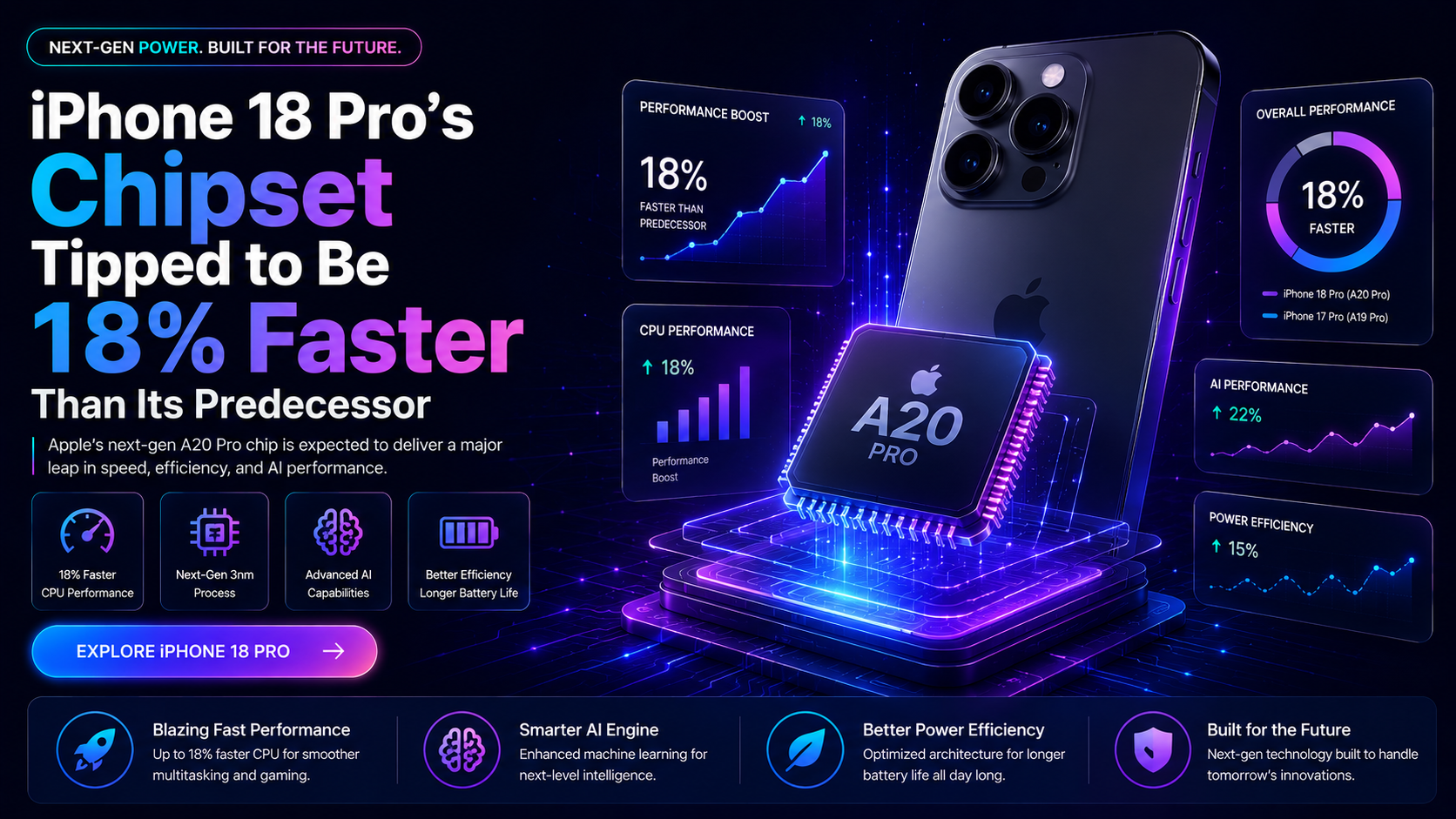
According to Weibo tipster Fixed Focus Digital, Apple’s next flagship processor, widely expected to be called the A20 Pro, will deliver around 18 percent more performance than the A19 Pro currently running the iPhone 17 Pro. That’s not a jaw-dropping number on paper. But it’s coming from a genuinely new place: TSMC’s 2-nanometer process, built on Gate-All-Around transistor technology instead of the FinFET design Apple’s chips have used for years. And that shift alone is a bigger structural change than most of the yearly A-series refreshes we’ve seen since the first FinFET chips showed up.
It’s still early days for this leak, and it’s worth saying upfront: nothing here is confirmed by Apple. Fixed Focus Digital has a mixed track record on iPhone specifics, though their supply-chain reporting on TSMC’s manufacturing roadmap has generally lined up with what other analysts have said. So take the specific 18 percent figure as a reasonable estimate, not gospel.
What’s Actually Changing Inside the Chip
Here’s the thing about node shrinks — they rarely translate into a straight, predictable performance bump. Smaller transistors mean more of them fit into the same space, and GAA transistors wrap the gate material around all four sides of the channel instead of three, giving Apple’s engineers tighter control over current leakage. In plain terms: less wasted power, better switching behavior, and, in theory, more headroom to push clock speeds without cooking the phone.
TSMC’s own numbers for the N2 process suggest a 10 to 15 percent speed gain at the same power draw, or a 25 to 30 percent cut in power consumption at the same performance level, compared to the older N3E node. Apple’s version of the story — an 18 percent speed bump paired with a 30 percent efficiency gain — sits comfortably inside that range, which is honestly one reason this leak feels more credible than some of the wilder rumors that float around every August.
That efficiency side is where the leak gets more interesting than the speed claim, if you ask me. The same report pegs power consumption as dropping by roughly 30 percent compared to the A19 Pro. If that number is even close to accurate, it matters more day-to-day than raw benchmark scores do. Most people don’t sit around running Geekbench for fun. They do notice when their phone survives a full day without a top-up, or when it doesn’t get warm during a long video call.
It’s also worth remembering this chip won’t be flying solo. Reports point to Apple pairing it with Wafer-Level Multi-Chip Module packaging, or WMCM, which puts RAM directly on the same wafer as the CPU, GPU, and Neural Engine rather than connecting it through a separate interposer sitting next to the chip. That’s less a raw speed trick and more a space-and-efficiency one. It should free up physical room inside the phone for other components — maybe a bigger battery, maybe better cooling — and could help with the kind of on-device AI tasks Apple’s been leaning into ever since Apple Intelligence launched.
Higher Transistor Density, Bigger Neural Engine
Beyond the headline number, a handful of related leaks paint a fuller picture. Transistor density on TSMC’s 2nm process is expected to climb by up to 20 percent over the current 3nm node, which is where a lot of the efficiency and performance gains actually come from — more logic packed into less silicon. Some reports also point to a bigger Neural Engine on the A20 Pro, which would make sense given how much of Apple’s software roadmap now leans on on-device machine learning for things like camera processing, Siri, and writing tools.
None of this is happening in a vacuum, either. Qualcomm and MediaTek are both pushing their own flagship chips forward at the same time, and by the time the A20 Pro actually ships, it’ll already be facing competition from the next-generation Snapdragon 8 Elite Gen 6 and Dimensity 9600. Some early comparisons suggest Qualcomm’s next chip could post even bigger raw performance gains on paper. But Apple has historically leaned on sustained performance and thermal management rather than chasing peak benchmark numbers, so a smaller headline jump doesn’t necessarily mean a worse real-world experience.
Why the Upgrade Might Not Feel Huge — Yet
Now, an 18 percent jump sounds modest next to some of the leaps we’ve seen in past Apple silicon generations, and a few outlets have already framed it that way. If you’re already carrying an iPhone 17 Pro, you probably won’t feel a dramatic difference in everyday use. Scrolling, texting, opening apps — none of that stresses a modern A-series chip hard enough to notice an 18 percent gap. Where it’ll actually show up is in sustained workloads: longer gaming sessions, video editing, heavier AI-driven camera processing, that sort of thing.
Coming from an older phone, though — say a 15 Pro or earlier — the difference should be much more obvious, especially paired with better battery behavior. Apple tends to market these generational chip upgrades as bigger deals than they feel in daily use, and this one probably won’t be an exception. Expect the keynote language to lean hard on words like “revolutionary” and “breakthrough,” even if the actual felt difference for most people ends up being modest.
There’s a cost angle too, and it’s not a small one. Manufacturing on a first-generation 2nm process is expensive — TSMC has reportedly told Apple that 2nm chip pricing could run at least 50 percent higher than 3nm, purely because of how new and complex the equipment and yields are at this stage. Multiple reports suggest Apple’s bill of materials for the iPhone 18 Pro could rise by as much as 40 percent as a result. Combine that with an ongoing memory shortage across the industry — something that’s been squeezing several smartphone makers this year, not just Apple — and you get the rumored starting price floating around $1,399. That would be a noticeable jump from what current Pro models cost, and it’s not hard to imagine some buyers deciding to sit this generation out and wait for prices to settle.
What It Means for Developers and Everyday Buyers
For app developers and the businesses building on iOS, a chip like this — more Neural Engine headroom, better sustained performance, tighter power draw — usually opens the door to smoother AI features and richer real-time processing without draining a battery in three hours. Agencies that build and optimize mobile experiences, Technoholic among them, tend to pay close attention to these silicon shifts, since they often decide what’s actually feasible to ship on-device versus what still needs to be offloaded to a server. A more capable Neural Engine, for instance, can be the difference between running a feature locally versus routing it through the cloud, which affects everything from app speed to user privacy to server costs.
For everyday buyers, the calculus is simpler: faster chip, better efficiency, higher price tag. Whether that trade-off is worth it really depends on what you’re using your phone for and what you’re currently carrying. Someone doing heavy on-the-go editing or gaming will feel the difference more than someone who mostly texts and scrolls social media.
None of these figures are official — Apple hasn’t confirmed a single spec, and it rarely comments on chip details until launch day itself. So treat the 18 percent number as a leak, not a promise. Apple’s event is expected sometime next month, alongside the debut of its first foldable iPhone, and that’s when we’ll finally find out how much of this actually holds up under real testing. Until then, if you want to keep tabs on how the rumors evolve — and there will be more of them before launch — Google Tech News is a solid place to keep an eye on things as they develop.
So is an 18 percent performance gain worth getting excited about? Depends entirely on what phone you’re coming from, how you actually use it, and how much you’re willing to pay to get it. For some, it’ll be an easy upgrade. For others, it might just be a reason to hold onto the 17 Pro a little longer.