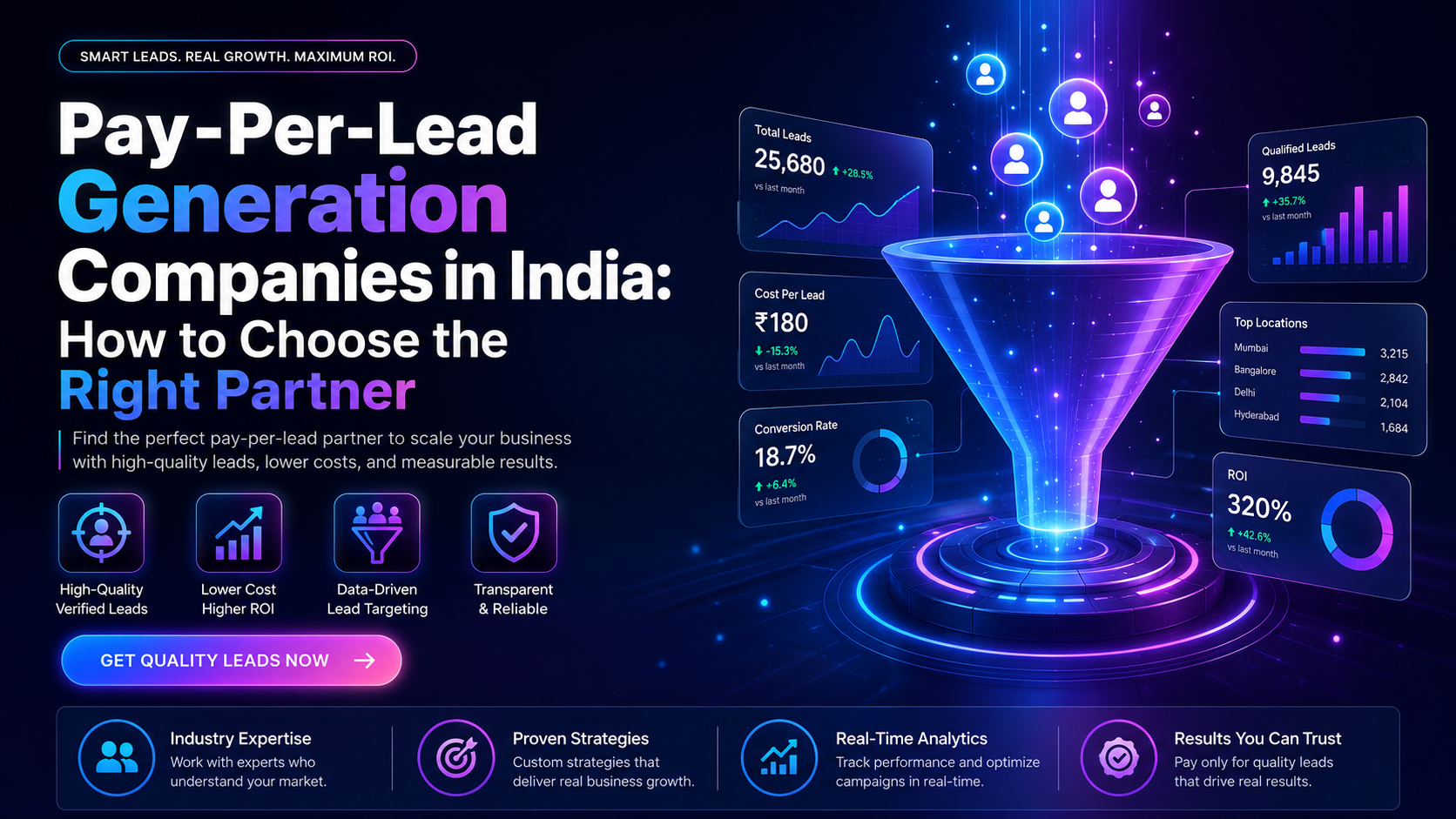
If you’ve ever felt like you’re throwing money into a marketing black hole, you’re not alone. Plenty of Indian businesses — from real estate developers to SaaS startups to insurance agents — have burned through ad budgets chasing “impressions” and “engagement” that never turned into an actual sale. That’s exactly why pay-per-lead (PPL) generation has become such an attractive model over the last few years. You pay only when you get something tangible: a verified lead, a phone number, someone who actually wants what you’re selling.
But here’s the catch. Not every company calling itself a “pay-per-lead agency” is actually delivering quality leads. Some are recycling the same contact list across five different clients. Others count a random form-fill as a “lead” even if the person never answers a call. Picking the wrong partner doesn’t just waste money — it wastes your sales team’s time, which honestly might be worse.
So let’s break down what pay-per-lead generation actually means, how the model works in India specifically, and what you should be looking for before you sign a contract.
What Does Pay-Per-Lead Actually Mean?
At its core, pay-per-lead is a pricing model where you compensate the agency based on the number of qualified leads they generate for you — not based on ad spend, not based on hours worked, not based on how many social posts they scheduled. You define what counts as a “lead” upfront (a phone number with intent, a completed application, a scheduled consultation, whatever fits your business), and the agency gets paid per unit delivered.
This is different from pay-per-click, where you’re charged for traffic regardless of whether that traffic converts. It’s also different from a retainer model, where you pay a flat monthly fee whether the results are great or mediocre. With PPL, the risk shifts substantially toward the agency. They only make money if they actually produce results for you. That alignment of incentives is, frankly, the whole appeal.
Of course, nothing’s free of trade-offs. Because the agency bears more risk, the per-lead cost tends to be higher than what you’d pay for raw ad impressions. And some providers try to cut corners on lead quality to hit volume targets. Which brings us to the real question — how do you tell a good pay-per-lead company from a bad one?
Why Businesses in India Are Leaning Into This Model
India’s digital ad market has gotten expensive and noisy. Google and Meta ad costs have climbed steadily across most competitive sectors — real estate, education, finance, healthcare — and smaller businesses often can’t out-bid larger players on a pure impressions-based auction. Pay-per-lead levels the playing field a bit, because you’re not competing purely on ad budget size. You’re relying on the agency’s targeting skill, their landing page conversion expertise, and their ability to filter out junk before it ever reaches you.
There’s also a trust factor at play. A lot of Indian SMBs have been burned before by agencies promising “brand awareness” or “reach” with no clear connection to revenue. Founders and marketing heads have gotten understandably skeptical of vague metrics. Pay-per-lead cuts through that. You know exactly what you’re paying for, and you can measure ROI almost immediately instead of waiting months for a “brand lift study” that may or may not mean anything.
Sectors like real estate, insurance, education consultancies, home services, B2B SaaS, and financial services have adopted PPL particularly fast in India — mostly because these industries have a clear, well-defined sales funnel where a “lead” is easy to define and easy to hand off to a sales or telecalling team.
How the Process Typically Works
A decent pay-per-lead partner will usually start by understanding your ideal customer — not just demographics, but intent signals too. Are you targeting people actively searching for a 2BHK in Pune, or people vaguely browsing real estate content? That distinction matters enormously for lead quality.
From there, they’ll typically run a mix of paid campaigns — Google Search, Meta, sometimes programmatic display — driving traffic to optimized landing pages built specifically to capture intent, not just clicks. Forms get filtered through validation rules, sometimes even a quick verification call, before a lead is marked as “delivered” and billed to you. Good agencies will also build in some kind of quality guarantee: if a lead turns out to be fake, duplicate, or outside your target criteria, you shouldn’t be paying for it.
That last part is where a lot of shady operators fall apart. Ask any business owner who’s tried three or four lead-gen vendors, and they’ll tell you the difference between a great partner and a mediocre one usually comes down to that filtering step. Anyone can generate form submissions. Generating submissions from people who genuinely intend to buy — that’s the actual skill.
What Separates a Good Pay-Per-Lead Company From a Bad One
Honestly, this is the part most businesses get wrong, because it’s tempting to just look at the price per lead and pick whoever’s cheapest. Don’t do that. A ₹150 lead that never picks up the phone is more expensive than a ₹400 lead that converts into a sale. Instead, look at a handful of things together.
First, ask how they define and validate a lead. Vague answers here are a red flag. Second, ask for references or case studies from businesses in your specific industry — a company that’s great at generating leads for gyms might have no idea how to generate leads for enterprise software. Third, check whether they offer any kind of replacement or refund policy for invalid leads. Fourth, find out if they’re running fresh campaigns for you or recycling traffic across multiple clients in your category (this happens more than you’d think, and it tanks conversion rates). And fifth — this one gets overlooked constantly — ask about data compliance. With India’s data protection regulations tightening, you want a partner who’s collecting and handling consumer data properly, not scraping numbers from sketchy sources.
It also helps to have a short trial period before committing to a large volume. Most reputable agencies — providers like Technoholic, for instance, among others operating in this space — will happily start with a smaller batch of leads so you can judge quality firsthand before scaling spend. If a company pressures you into a huge upfront commitment with no trial phase, that’s worth being cautious about.
Red Flags to Watch Out For
A few warning signs tend to show up again and again. Guaranteed “conversion rates” are one — no honest agency can promise you’ll close a fixed percentage of leads, because that depends on your sales team too, not just lead quality. Unusually low per-lead pricing compared to industry norms is another; if it seems too cheap to be real, it probably involves recycled or low-intent traffic. Watch out too for vendors who won’t specify exactly what counts as a “qualified” lead in writing before you sign anything. And if they can’t explain, even roughly, where the traffic is coming from — which channels, which targeting approach — that’s a conversation you need to have before handing over a rupee.
Making the Final Decision
There isn’t one universally “best” pay-per-lead company for every business — a real estate developer in Gurugram and an ed-tech startup in Bangalore have pretty different needs. What matters more is finding a partner whose process is transparent, whose lead definitions match your actual sales process, and who’s willing to prove quality before asking for scale.
Start small, track your close rate (not just the lead count), and be willing to walk away if the numbers don’t add up after a fair trial period. The right partner will welcome that scrutiny, not resist it.
And if you want to stay on top of how digital marketing and lead-gen strategies keep evolving in India, it’s worth keeping an eye on Google Tech News every now and then — the ad platforms and privacy rules that shape this whole industry shift more often than most of us have time to track.